The Digital Freight Infrastructure Journal : Article 7 of 12
A single international air shipment can generate dozens: or even hundreds: of emails.
Rate requests. Booking confirmations. Air waybill corrections. Document requests. Customs updates. Warehouse notifications. Pickup instructions. Flight changes. Exception alerts. Delivery confirmations.
Email is not merely used in logistics. In many operations, it is the de facto coordination layer.
That is the uncomfortable truth.
The logistics industry’s most-used coordination tool became dominant not because it was designed for freight execution, but because it was the only tool that could cross organizational boundaries without requiring everyone to adopt the same system.
That made email universal.
It also made fragmentation difficult to see.
Why Email Won
Email solved one problem exceptionally well: communication between organizations that did not share systems.
Every airline had it. Every freight forwarder had it. Every GSA, trucking provider, warehouse, customs broker, airport, government agency, and customer had it.
No common implementation was required. No integration project had to be approved. No partner had to change its operating model. An organization could send a message across a firewall, across a time zone, and across a company boundary in seconds.
For a fragmented industry, that was a powerful advantage.
A typical air cargo movement involves multiple independent parties:
- The shipper or consignor
- The freight forwarder or cargo agent
- The airline or carrier
- Origin and destination ground handlers
- Customs authorities and brokers
- Trucking providers
- Airports and warehouse operators
- The consignee or receiving organization
Each party may have its own systems, procedures, service commitments, and internal priorities. Email became the common denominator.
It allowed one organization to ask another for a rate, request a booking, submit documents, confirm a handoff, or escalate a delay: without needing access to the other party’s technology.
Email won because it demanded nothing from the network.
The Inbox Became a Workflow by Default
Over time, the logistics industry began using email for work that required much more than messaging.
An email thread might contain:
- A commercial request
- A shipment identifier
- A booking decision
- A list of missing documents
- A revised cutoff time
- A change in ownership
- A request for confirmation
- A recovery action
- A final delivery update
The conversation became the record of execution.
But a conversation is not a workflow.
A workflow defines the required action, the responsible party, the deadline, the next step, and the condition that moves the process forward. An inbox does none of those things reliably.
Email can communicate that a task exists. It does not ensure that the task is accepted, completed, escalated, or connected to the next operational event.
That distinction matters.
The Hidden Cost of Email-Based Coordination
Email is asynchronous, unstructured, and largely unaccountable.
Messages wait until someone opens them. Replies depend on individual judgment. Urgency is communicated through subject lines, capitalization, follow-up messages, or phone calls. Critical details may be buried several replies deep in a thread.
Nothing automatically triggers when a response is late.
Nothing escalates when a booking confirmation does not arrive.
Nothing reliably identifies which stakeholder owns the next action.
The operational cost appears in familiar forms:
- Missed booking or cargo acceptance cutoffs
- Repeated requests for the same information
- Documents distributed across multiple threads
- Conflicting versions of shipment status
- Delayed responses across time zones
- Unclear responsibility during exceptions
- Manual reconciliation between systems and inboxes
- Staff spending hours “chasing” updates
- Difficulty proving when a handoff occurred or failed
Research and industry commentary consistently identify these patterns in air cargo and logistics operations. When damage, loss, or delay cases are handled through long email chains, teams can lose visibility into the current status, the actions already taken, and the party responsible for resolution. CargoHub describes this problem in the context of air cargo tracing and recovery cases.
The cost is not limited to administrative inconvenience.
A stalled response can become a missed flight. A missing document can become a customs hold. An unclear pickup instruction can leave cargo sitting at a warehouse. A late escalation can turn a recoverable exception into a customer-impacting failure.
Email does not cause every delay. But it often makes delay harder to detect, assign, and resolve.

Email Masks Fragmentation Instead of Solving It
The deeper problem is that email allows fragmented operations to appear functional.
As long as someone is forwarding messages, copying stakeholders, requesting updates, and maintaining a spreadsheet, the process continues to move. The organization may look responsive from the outside.
But the execution model remains dependent on individual memory and persistence.
The most experienced operator often becomes the unofficial coordination system. That person knows which airline contact responds quickly, which warehouse requires a separate pre-alert, which customs broker needs a document resent, and which trucking provider must be called rather than emailed.
This knowledge is valuable: but it is not infrastructure.
When that operator is unavailable, the process becomes slower. When shipment volume increases, the model becomes harder to scale. When a new partner enters the network, the organization must recreate the same knowledge through manual instruction and repeated follow-up.
The industry normalized this condition.
Two hundred emails for one complex shipment became “just how it works.”
The Fragmentation Trap
Email is particularly effective at preserving organizational boundaries.
The airline owns one part of the process. The forwarder owns another. The trucker, warehouse, customs broker, and consignee each control different actions. Email moves information between them, but it does not create shared operational ownership.
That creates a fragmentation trap:
- Each party communicates from its own system and priorities.
- Email becomes the bridge between organizations.
- The bridge carries messages but not structured accountability.
- Teams compensate with follow-ups, spreadsheets, calls, and manual escalation.
- The additional activity is mistaken for coordination.
The result is more communication without more control.
The World Bank’s work on trade and logistics modernization and industry guidance from organizations such as IATA point toward a broader reality: effective cargo execution depends on coordination among multiple stakeholders, not simply on the availability of data.
The industry has improved its ability to generate information.
It has not solved the problem of turning that information into coordinated action.
Why the Email Model Is Breaking Down
The email-based model was more manageable when shipment volumes were lower, partner networks were smaller, and operational complexity was easier to absorb through experienced personnel.
Those conditions no longer hold consistently.
Organizations now manage:
- More origin and destination combinations
- More specialized cargo requirements
- Tighter service commitments
- More regulatory and documentation requirements
- More subcontractors and ecosystem partners
- Greater demand for real-time status
- Higher expectations for auditability and reporting
At the same time, many operations remain dependent on systems that were designed for individual organizations rather than shared execution across multiple companies.
Visibility platforms can show where freight is located. Booking systems can record transactions. TMS and ERP platforms can manage internal processes. Email can connect the participants.
But the industry still needs a layer that coordinates what happens between those systems and organizations.
That is the missing layer.

From an Inbox to an Execution Layer
The shift is not necessarily from email to another isolated application.
It is from unstructured communication to structured execution.
A real coordination layer should make the operational state of a shipment clear:
- What has happened?
- What must happen next?
- Who owns the next action?
- When is it due?
- What information or document is required?
- What happens if the action is late?
- Which stakeholders need visibility?
- What evidence confirms completion?
This is different from simply adding another dashboard.
A dashboard displays information. An execution layer organizes work around that information.
For example, a shipment workflow can be structured from quote → booking → tracking → delivery, with each transition tied to a defined owner and event. A booking request can trigger a required confirmation. A missing document can create an assigned task. A missed milestone can initiate escalation. A handoff can produce an auditable record rather than another email thread.
The goal is not to eliminate every message.
Email will remain useful for many forms of communication. The goal is to stop using the inbox as the system of record for operational execution.
The Next Logistics Platform Is a Layer
The next logistics platform is not necessarily another application that asks every participant to start over.
It is the layer that works across the systems already in use.
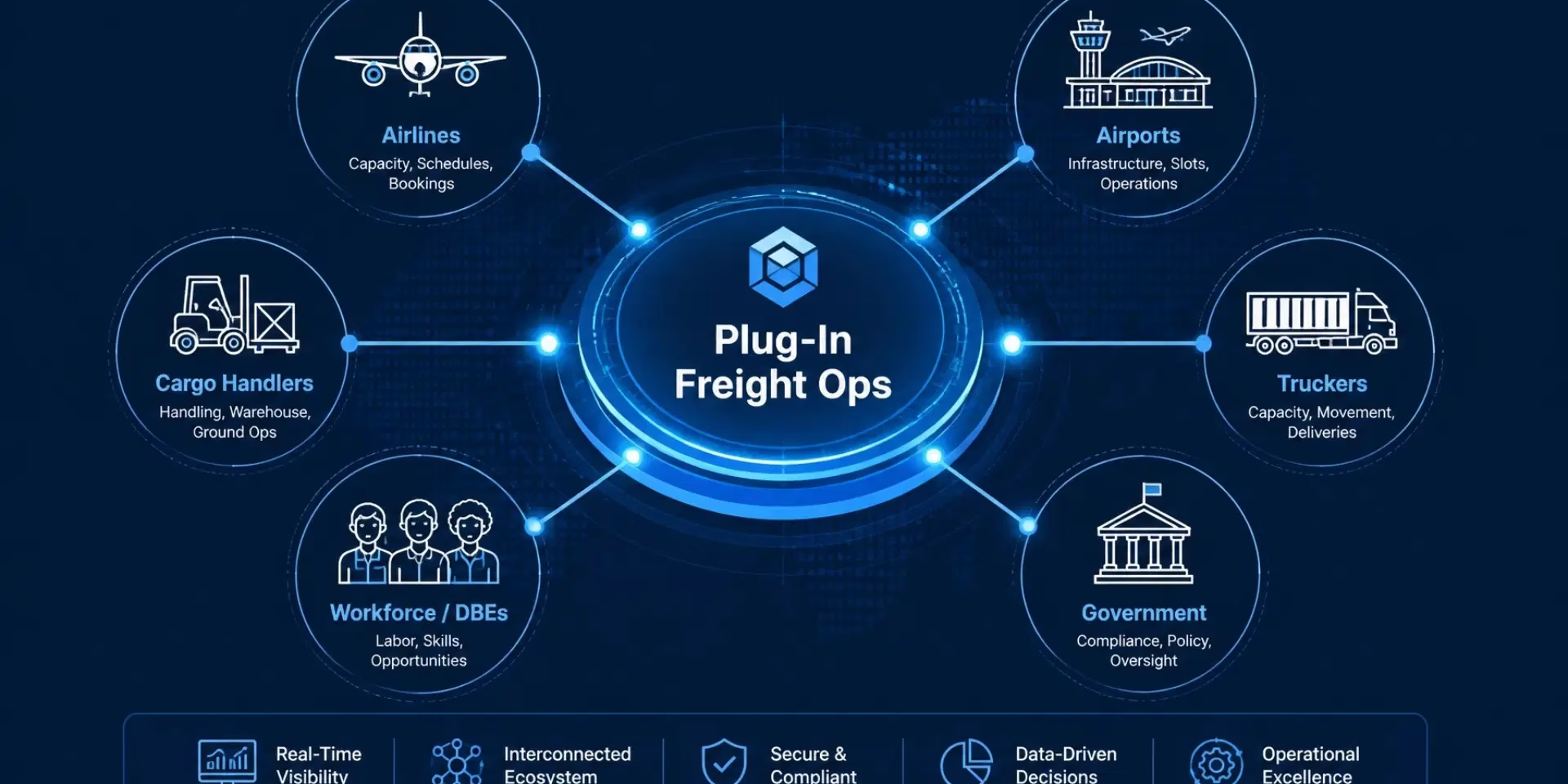
That layer must coordinate airlines, GSAs, freight forwarders, trucking providers, ground handlers, warehouses, government stakeholders, and other partners without requiring every organization to replace its existing technology.
This is the logic behind digital freight infrastructure: a connective execution layer that standardizes handoffs, creates shared visibility, and establishes accountability across fragmented environments.
Plug-In Freight Ops™ represents that model.
Its significance is not that it replaces email with a more modern inbox. Its significance is that it treats freight coordination as infrastructure: a structured operating layer above existing systems that connects quoting, booking, tracking, reporting, and partner execution.
The objective is straightforward:
Every handoff should have a defined owner, a defined next step, and a defined trigger.
When that standard is in place, email can return to its proper role: communication.
It no longer has to carry the entire burden of execution.
The Industry Has Outgrown Its Default Tool
Email became the world’s largest logistics platform because it was universal, accessible, and independent of organizational boundaries.
Those same characteristics now expose its limits.
It connects people, but not reliably defined actions. It distributes information, but does not create shared accountability. It preserves conversations, but does not consistently produce execution certainty.
The industry does not need more email discipline alone. It needs an operating model that reduces the number of execution decisions left to inbox management.
That is the next phase of freight modernization.
Not replacing every system.
Not adding another disconnected destination for data.
Building the coordination layer that makes fragmented execution visible, assignable, measurable, and controllable.
We typically address this through a focused pilot around a defined shipment flow, handoff sequence, or partner network. The practical question is not whether an organization uses email.
Everyone does.
The question is which parts of execution should still depend on it.
About the Author
Michelle DeFronzo is Founder and CEO of ImEx Cargo, a woman-owned logistics and freight-technology company. With more than 30 years in global logistics, she builds modular infrastructure that modernizes access and collaboration without requiring organizations to replace the systems already in use.
Her work focuses on platform strategy, ecosystem design, and operational coordination across fragmented industries. Through Plug-In Freight Ops™, she advances a simple principle: collaboration is not soft; it is scalable.