For years, the logistics industry treated integration as the answer to fragmentation.
Connect the TMS to the WMS. Connect the forwarder to the airline. Connect the carrier to the customer portal. Use APIs, EDI, webhooks, data standards, and shared records to make information move faster.
That work has created real progress. Data is more accessible. Shipment events can be exchanged with greater speed. Standards such as IATA ONE Record are creating a more consistent foundation for digital air cargo.
But a critical gap remains.
Data moving between systems is not the same as work moving between stakeholders.
Connected systems can still produce fragmented execution. The next stage of digital freight is not simply more integration. It is coordination.
The Integration Era Made Data Flow
Integration is technical by nature.
It connects applications, databases, platforms, and communication channels so information can be exchanged without repeated manual entry. EDI established structured document exchange between trading partners. APIs introduced more flexible, real-time interactions between systems. Webhooks and event-driven architectures made it possible to react to changes as they occur.
In air cargo, the industry is also moving beyond traditional messaging toward data-centric models. IATA describes ONE Record as a standard for sharing a single shipment record through a common data model and secure web APIs.
These developments matter.
They can improve:
- Data availability
- Message consistency
- Shipment visibility
- System interoperability
- Speed of information exchange
- Access to shared shipment records
Yet the presence of a data connection does not establish who is responsible for the next operational action.
An API can transmit a status. It cannot, by itself, ensure that the right party reviews the status, accepts responsibility, updates the next milestone, and escalates the issue if the handoff stalls.
That is where integration ends: and coordination begins.

Integration Connects Systems. Coordination Connects Work.
The distinction is straightforward.
System integration moves data between systems.
Execution coordination moves work between stakeholders.
Integration answers questions such as:
- Can the airline system send a booking confirmation?
- Can the forwarder retrieve a shipment status?
- Can the trucking system publish a pickup event?
- Can the customer portal receive an updated ETA?
Coordination answers different questions:
- Who owns the next action?
- What must happen after the event is received?
- When is the action due?
- What constitutes completion?
- What happens if the responsible party does not respond?
- Who needs to be notified when a milestone changes?
One connects machines.
The other connects accountability.
In a complex shipment, the operational risk rarely exists inside one system. It exists between the forwarder and the airline, between the airline and the ground handler, between the handler and the trucker, or between the project owner and the many suppliers responsible for execution.
These handoffs are where delays become difficult to see and even harder to assign.
The False Promise of “Just Integrate”
“Just integrate the systems” sounds like a complete answer because many breakdowns appear to be information problems.
A booking is missing. A pickup status is late. A document has not been received. An exception appears in one platform but not another. The natural response is to build another connection.
But a new connection does not automatically create a new operating model.
A shipment email chain can continue even after APIs are live. A dispatcher can still call multiple partners to confirm a pickup. A forwarder can still maintain a spreadsheet to track open exceptions. A government or infrastructure program can still struggle to identify which organization owns a delayed deliverable.
The systems are connected. The execution remains disconnected.
This happens for several reasons:
- Data is exchanged without a shared workflow.
- Events are visible without assigned ownership.
- Milestones are recorded without defined completion criteria.
- Exceptions are generated without escalation paths.
- Partners receive information but not actionable responsibilities.
- Each organization measures activity inside its own system rather than across the entire handoff.
The result is a more connected version of the same fragmentation.
More data may be available, but no one has converted that data into controlled execution.
What Coordination Actually Requires
Execution coordination begins with the operational event, but it does not end there.
A coordination layer must translate events into managed work. That requires a disciplined sequence:
-
Define the next action
A booking confirmation, delay notice, missed pickup, or document update should trigger a specific operational response. -
Assign ownership
The responsible party must be identifiable. “The team” is not an accountable owner. -
Set timing and completion criteria
The workflow should establish when the action is due and what evidence confirms completion. -
Trigger the responsible stakeholder
The right airline, GSA, forwarder, trucker, handler, agency, prime contractor, or supplier must receive the relevant task. -
Track the handoff
Progress should remain visible across the shipment or program: not disappear inside a partner’s local system. -
Escalate when execution stalls
An unresolved task should move to the next level of accountability before it becomes a service failure.
This is not simply data transmission.
It is operational control across organizational boundaries.
For example, a shipment departure event may be received through an API, EDI message, or ONE Record notification. Integration makes that event available. Coordination determines what happens next:
- The tracking milestone is updated.
- The forwarder is notified.
- The consignee communication is prepared.
- The downstream delivery partner is alerted.
- A revised ETA is reviewed.
- An exception is opened if the timing conflicts with the delivery commitment.
The technology supplies the signal. The coordination model turns the signal into action.

Why Existing Systems Are Not Enough
Most organizations already have systems of record.
Airlines operate cargo management platforms. Forwarders use transportation management systems. Trucking providers manage dispatch and delivery activity. Airports and handlers maintain operational systems. Agencies, primes, and infrastructure firms often use project, procurement, and compliance platforms.
Replacing these systems is usually neither practical nor necessary.
The problem is that each system is optimized for a particular organization or function. It may accurately manage local activity while offering limited visibility into the work that must happen across the ecosystem.
This is why the next architecture is not necessarily a larger standalone system.
It is an execution layer above existing systems: one that standardizes the workflow between them.
That layer can coordinate:
- Quote-to-booking activity
- Capacity and partner responses
- Pickup and delivery handoffs
- Shipment milestones
- Documentation requirements
- Exception management
- Supplier and DBE participation
- Program-level reporting
- Audit-ready accountability
The purpose is not to replace operational expertise. It is to make responsibilities, dependencies, and stalled work visible across the network.
The Evolution: From Connectivity to Execution
The industry is moving through a clear progression.
First came integration.
The priority was connecting systems and eliminating isolated data.
Next came visibility.
The priority was seeing shipment status, milestones, and exceptions in a more consistent way.
Now comes coordination.
The priority is ensuring that visibility leads to action across multiple organizations.
This transition changes the design question.
Instead of asking, “Which systems should we integrate?” organizations must also ask:
- Which workflows cross organizational boundaries?
- Where do handoffs routinely fail?
- Which events require action rather than observation?
- How is partner accountability measured?
- How quickly are exceptions escalated?
- Can execution be reviewed across the full lifecycle?
The answer may involve APIs, EDI, ONE Record, portals, or other data channels. But those technologies are inputs to the operating model: not the operating model itself.

Digital Freight Infrastructure Is the Logical Conclusion
The emergence of digital freight infrastructure reflects this broader shift.
A digital execution infrastructure layer does not ask every participant to abandon existing tools. It provides a common coordination environment for the work that must move between them.
In this model, the sequence is clear:
Quote → Book → Track → Assign → Escalate → Report
Each stage creates responsibilities that may involve different companies, systems, and stakeholders. The coordination layer connects those responsibilities into one managed workflow.
That approach is relevant beyond individual shipments. It can support airport operations, air cargo networks, government transportation programs, infrastructure projects, certified DBE participation, and workforce activation: any environment where execution depends on multiple parties completing linked actions.
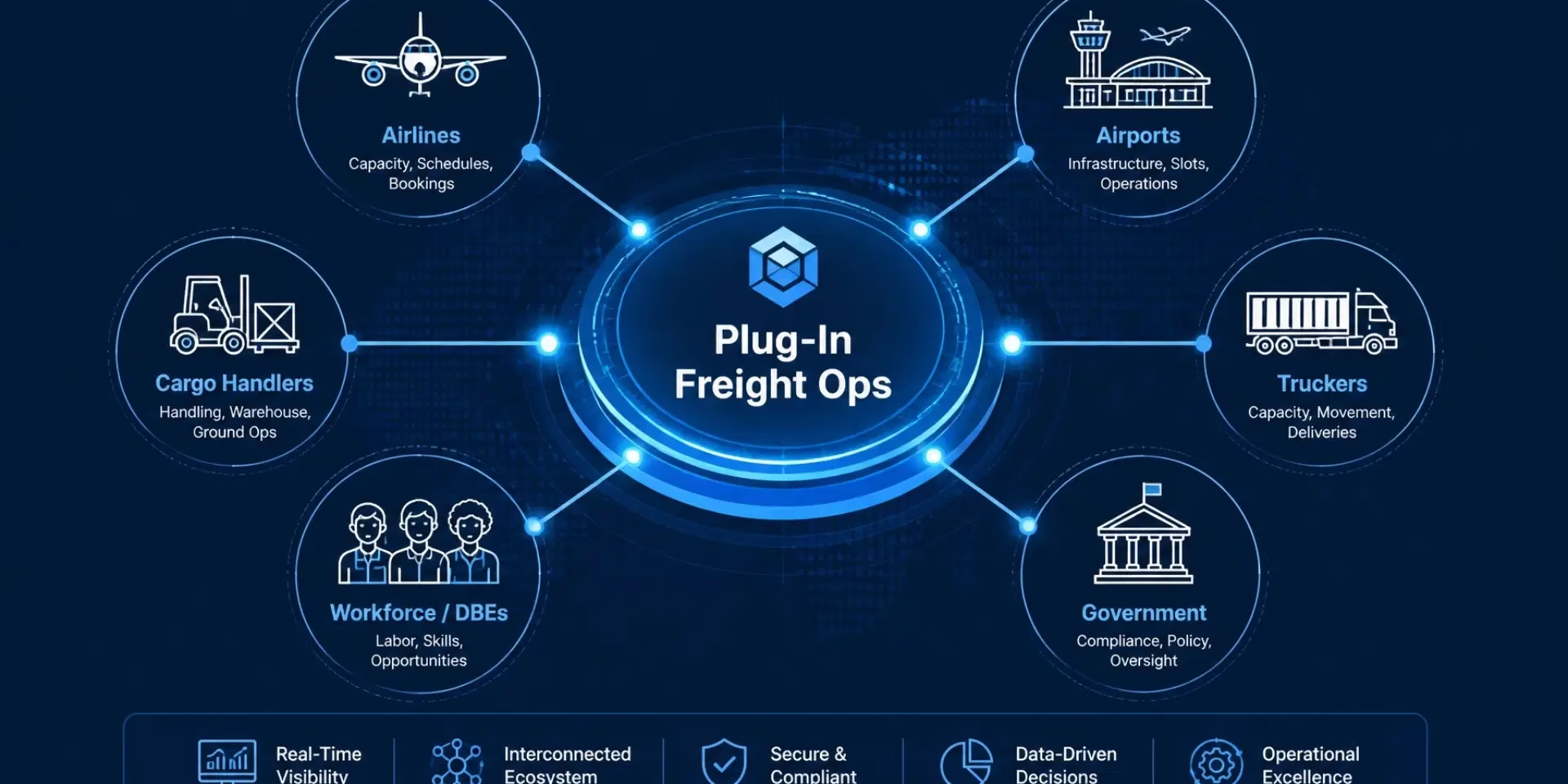
ImEx Cargo’s cargo coordination approach reflects this category shift. Plug-In Freight Ops™ is designed to sit above fragmented systems and coordinate the activity between airlines, GSAs, freight forwarders, truckers, handlers, government stakeholders, and partner ecosystems.
The strategic point is larger than any one platform.
Organizations that invest only in integration will have connected systems and fragmented operations.
The differentiator will not be who has the most APIs, the largest data lake, or the greatest number of system connections.
It will be who coordinates work most effectively across the ecosystem.
The Next Operating Advantage
Integration remains essential. EDI, APIs, and data standards are the foundation for modern freight execution.
But foundations do not complete the work.
The next advantage comes from converting shared data into assigned action, measurable handoffs, visible accountability, and timely escalation. That is how organizations reduce delays, limit operational risk, and gain control across fragmented execution environments.
The future of digital freight is not simply a network of connected systems.
It is a coordinated network of organizations capable of acting on shared information at the right time.
About Michelle DeFronzo
Michelle DeFronzo is the Founder and CEO of ImEx Cargo, with more than 30 years of experience across airfreight, ocean freight, domestic trucking, airline cargo GSA/GSSA operations, and government contracting. She leads the development of Plug-In Freight Ops™, a digital execution infrastructure approach designed to improve coordination, visibility, and accountability across complex transportation ecosystems.
Michelle also leads ImEx Cargo Academy, which provides practical logistics education, workforce development, and transportation career readiness programs.