Where does execution break down?
It rarely happens within your own department. Most organizations have spent millions perfecting their internal operations. They have robust Enterprise Resource Planning (ERP) systems that track every penny, every pallet, and every person under their direct control.
But the moment a shipment leaves your warehouse, crosses a border, or requires a handoff to an airline, freight forwarder, or trucking partner, the ERP hits a wall.
That wall is the edge of your enterprise.
To bridge this gap, the industry is moving toward a new architectural model: Digital Freight Infrastructure. While an ERP manages your enterprise resources, a coordination layer: like Plug-In Freight Ops™: manages your enterprise collaboration.
What is an ERP? (The System of Record)
Enterprise Resource Planning (ERP) systems are the backbone of modern business. They were designed to integrate internal functions: finance, inventory, purchasing, accounting, and manufacturing: into a single, unified database.
In the context of logistics, an ERP is your System of Record. It tells you:
- How much inventory you have in stock.
- The financial cost of a shipment.
- When a purchase order was generated.
- Which internal employee is responsible for an order.
ERP systems work exceptionally well for everything inside your "four walls." They ensure data integrity and financial compliance. However, they are inherently "inward-looking." They treat external partners as data inputs rather than active participants in a shared execution workflow.
What is a Coordination Layer? (The System of Coordination)
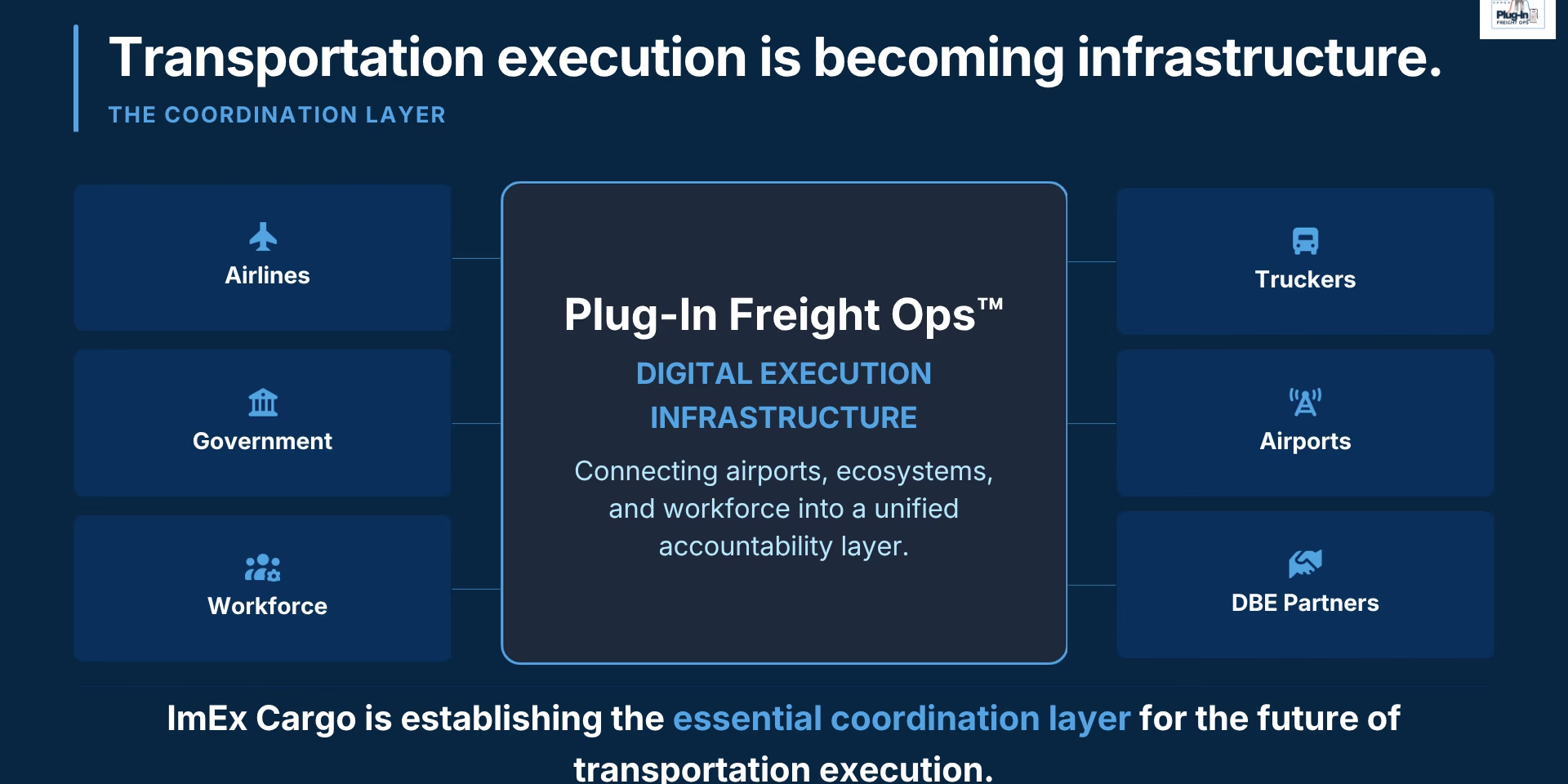
A coordination layer, or logistics orchestration platform, is a digital execution infrastructure designed to manage activities across fragmented, multi-stakeholder environments.
Unlike an ERP, which focuses on resources, a coordination layer focuses on execution events. It sits above your existing systems: ERP, TMS, WMS: to standardize and manage the full shipment lifecycle across the entire ecosystem.

This ecosystem coordination layer connects:
- Airlines and GSAs managing capacity and bookings.
- Freight Forwarders handling multi-party shipment flows.
- Trucking Providers managing the first and last mile.
- Government Agencies overseeing compliance and infrastructure.
- Workforce Partners feeding the talent pipeline into the operation.
The Execution Gap: Why ERPs Aren’t Enough
The primary reason execution fails in complex logistics isn't a lack of data; it’s a lack of multi-stakeholder execution capability.
When a shipment is delayed at a terminal, your ERP might eventually show a status update. But it won't facilitate the real-time handoff between the trucker, the ground handler, and the airline to fix the issue. That usually happens via frantic emails, phone calls, and manual spreadsheets.
This is the "Execution Gap."
By implementing neutral coordination infrastructure, organizations can move from simple visibility (knowing where a shipment is) to actual cargo execution command center capabilities (knowing what should happen next and ensuring it does).
Capability Comparison: ERP vs. Coordination Layer
| Capability | Enterprise Resource Planning (ERP) | Coordination Layer (Plug-In Freight Ops™) |
|---|---|---|
| Primary Focus | Internal Resource Management | External Execution Coordination |
| Data Ownership | Single Organization | Multi-Stakeholder Ecosystem |
| Core Functions | Finance, Accounting, Inventory | Workflows, Handoffs, Accountability |
| Time Horizon | Planning & Historical Records | Real-Time Execution & Exceptions |
| External Collaboration | Limited (EDI/Portal) | Deep (Integrated Workflows) |
| System Role | System of Record | System of Coordination |
| Workforce Integration | Internal HR | Workforce Activation Infrastructure |
A Layered Architecture: How They Work Together
Choosing between an ERP and a coordination layer is a false dilemma. Modern cargo execution infrastructure is designed to complement, not replace, your existing technology stack.
Think of it as a stack:
- The Resource Layer (ERP): Manages your orders, finances, and internal assets.
- The Transaction Layer (TMS/WMS): Manages specific transportation or warehouse tasks.
- The Coordination Layer (Plug-In Freight Ops™): Orchestrates the handoffs and communication between your systems and your partners' systems.
This "Plug-In" approach allows you to maintain your investment in a heavy-duty ERP while gaining the agility of a freight operating system that can talk to anyone, anywhere, in real time.

Beyond Data: Governed Logistics Orchestration
One of the most significant advantages of a coordination layer is the ability to enforce governed logistics orchestration.
In high-stakes environments: such as government logistics or large-scale infrastructure projects: it isn't enough to just move freight. You must also meet compliance, diversity, and workforce goals.
A coordination layer can bake these requirements into the execution workflow. It can automatically verify DBE (Disadvantaged Business Enterprise) participation, track workforce development milestones, and ensure that every partner in the chain is meeting their contractual performance obligations.
An ERP tracks if you paid the vendor; a coordination layer tracks if the vendor actually delivered the impact they promised.
Why the Industry is Shifting to "Operating Systems"
We are seeing a shift from siloed software to a logistics operating system model. This shift recognizes that supply chains are not linear chains but interconnected webs.
When you use digital freight infrastructure, you are building a resilient network that can withstand disruptions. If one airline is grounded or one port is blocked, the coordination layer allows for rapid, structured re-routing across the entire partner ecosystem: something that would take days of manual data entry in a traditional ERP environment.
Closing the Coordination Gap
If your operation is still relying on an ERP to manage multi-party execution, you are likely leaving money on the table through delays, manual labor, and lack of accountability.
ImEx Cargo provides the supply chain execution layer needed to turn fragmented logistics into a coordinated execution engine. We don't ask you to rip and replace your ERP. We ask you to "plug in" the coordination you’ve been missing.
Ready to see how a coordination layer fits into your current technology ecosystem?
We typically address this through a focused pilot program that maps our infrastructure to your current operation. Contact us today to discuss a capability walkthrough or start a partnership conversation.