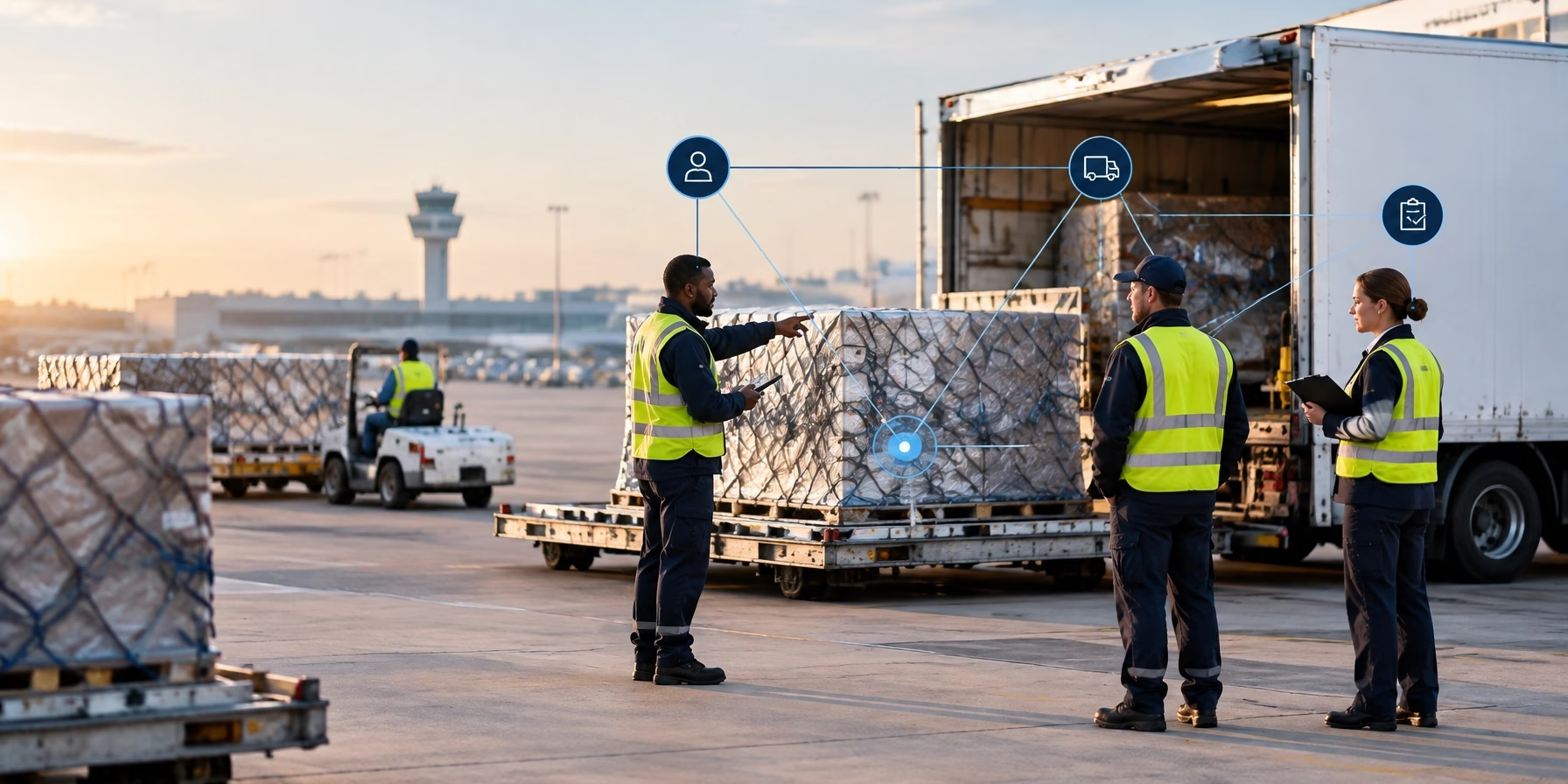
Most freight companies are not coordinating work from one shared process. They are exchanging messages about work.
A forwarder checks one system. A carrier checks another. A trucking provider confirms activity by email or phone. A handler updates a separate operational record. The customer sees a status, but no one has a shared view of who owns the next action.
That is the central challenge in multi-party freight execution.
The solution is not necessarily another system for every participant. It is a shared execution process that sits across existing organizations, tools, and handoffs.
Industry Shift: Freight Execution Crosses Organizational Boundaries
A shipment may involve a shipper, freight forwarder, airline, GSA, trucking provider, warehouse, ground handler, customs broker, consignee, and government stakeholder.
Each organization has a legitimate role. Each may have its own system, operating procedures, service commitments, and internal definition of status.
The shipment, however, experiences one continuous journey.
That creates a structural gap:
- The forwarder owns the customer relationship.
- The airline manages capacity and transport movement.
- The trucking provider manages ground movement.
- The handler manages physical acceptance and preparation.
- Government stakeholders may manage compliance or security requirements.
- The consignee depends on all of them to complete the delivery.
When these parties work from separate processes, the shipment may be visible without being coordinated. Everyone can see that a delay occurred, but the network may still lack agreement about what happens next, who must act, and when the issue is considered resolved.
This is why multi-party freight execution cannot be managed only as a collection of company-level tasks.
It requires a shared operating process across organizational boundaries.
Execution Layer: One Process Does Not Mean One System
A shared operational workflow does not require every freight company to replace its existing platform.
It means that the participating organizations agree on how the work progresses across the full shipment lifecycle:
quote → booking → acceptance → movement → handoff → tracking → delivery
The shared process should make several things clear:
- What stage the shipment is in
- Which organization is responsible for the current activity
- Which party is expected to receive the next handoff
- What information must be available before work proceeds
- What constitutes completion of the current step
- Who owns the next action when conditions change
This is the difference between shared visibility and coordinated execution.
A dashboard may show that freight has arrived at a facility. A shared execution process should also clarify whether the receiving party has accepted it, whether the handoff is complete, and who is responsible for the next movement.
That accountability is often missing from conventional system-to-system exchanges.

The role of industry standards
Industry initiatives such as IATA ONE Record, Cargo iQ, and cargo community systems are important complements.
They support structured information exchange, common milestones, process consistency, and interoperability between participants.
But information exchange is not the same as assigned responsibility.
These standards and community systems help carry information across the network. The operating model around them still needs to establish who owns the next action and how the network responds when execution does not follow plan.
That distinction matters.
A shared record can tell participants what happened. A coordinated execution process must also tell the network what needs to happen next.
Network View: The Shipment Is the Shared Operating Context
Multiple freight companies can work from one execution process when the process is organized around the shipment journey rather than around one company’s internal workflow.
The network view recognizes that each participant contributes to the same movement while retaining its own operational role.
The objective is not to erase organizational boundaries. It is to make those boundaries manageable.
A practical shared process should give every participant a common understanding of:
- The shipment’s current position in the lifecycle
- The handoff currently in progress
- The organization responsible for the active step
- The organization expected to receive the next step
- The commitments that affect downstream participants
- The exception or change requiring attention
This allows an airline, forwarder, trucker, and handler to work from the same execution context without pretending they are the same company.
The shared context becomes the coordination point.
Visibility is necessary but not sufficient
Visibility answers questions such as:
- Where is the shipment?
- What milestone was last recorded?
- Has the freight departed?
- Has delivery occurred?
Execution accountability adds another layer:
- Who owns the next action?
- Has the receiving party acknowledged the handoff?
- What is preventing progress?
- Which stakeholders need to respond?
- What decision or intervention is required?
Without that second layer, the network can remain reactive. Participants continue to send messages, request updates, and reconcile separate records after the fact.
The issue is not always a lack of data. It is the lack of coordinated ownership around the data.
Use Cases: Where a Shared Execution Process Creates Clarity
1. Forwarder-to-carrier booking coordination
A forwarder may request capacity, receive a carrier response, confirm the booking, and prepare the shipment for movement.
A shared process clarifies the transition between commercial confirmation and operational readiness. It helps distinguish between a quote, a booking request, a confirmed booking, and freight that is actually ready to move.
That reduces ambiguity at the point where responsibility shifts from one organization to another.
2. Trucker-to-warehouse handoffs
A trucking provider may arrive with freight, while the warehouse or handler must receive, verify, stage, or prepare it for the next movement.
Tracking the truck’s arrival alone does not establish that the warehouse has accepted the freight.
A coordinated handoff process gives both parties a common point of reference for the transfer and makes the next responsible organization visible to the wider network.
3. Ground handling and airline coordination
Airlines and ground handlers often depend on one another for operational readiness, handling instructions, facility activity, and flight-related milestones.
A shared process can connect the operational event to the party responsible for acting on it. That is particularly important when a change affects the airline, handler, forwarder, and trucking provider at the same time.
4. Delivery and consignee coordination
At the final stage, delivery status may appear complete while questions remain about receipt, documentation, condition, or customer acceptance.
A coordinated process distinguishes between arrival, presentation, acceptance, and completed delivery. It gives the network a clearer basis for closing the execution cycle.
5. Government and infrastructure programs
Large infrastructure and public-sector logistics programs often involve prime contractors, transportation providers, agencies, certified DBEs, and workforce partners.
The same principle applies: participation must be connected to real operational work, not only listed in a plan or reported in a separate document.
A shared execution process can provide a common operating context for partner activation, accountability, and oversight without requiring every participant to use the same internal system.

Pilot Path: Start With One Cross-Company Execution Gap
Organizations do not need to redesign their entire logistics environment to examine this problem.
A focused pilot can begin with one recurring handoff that crosses company boundaries.
Examples include:
- Forwarder-to-carrier booking confirmation
- Truck arrival and warehouse acceptance
- Handler-to-airline operational coordination
- Airport transfer and recovery movement
- Delivery acceptance across multiple providers
The pilot discussion should focus on the operating problem, not on replacing systems.
Key questions include:
- Where does responsibility change hands?
- Where do participants rely on parallel messages?
- Which status updates do not result in a clear next action?
- Where is ownership unclear when an exception occurs?
- Which organizations need to coordinate but do not share the same workflow?
The goal is to define a common execution process that participating organizations can understand and use while continuing to operate within their existing environments.
That is the role of a neutral execution layer.
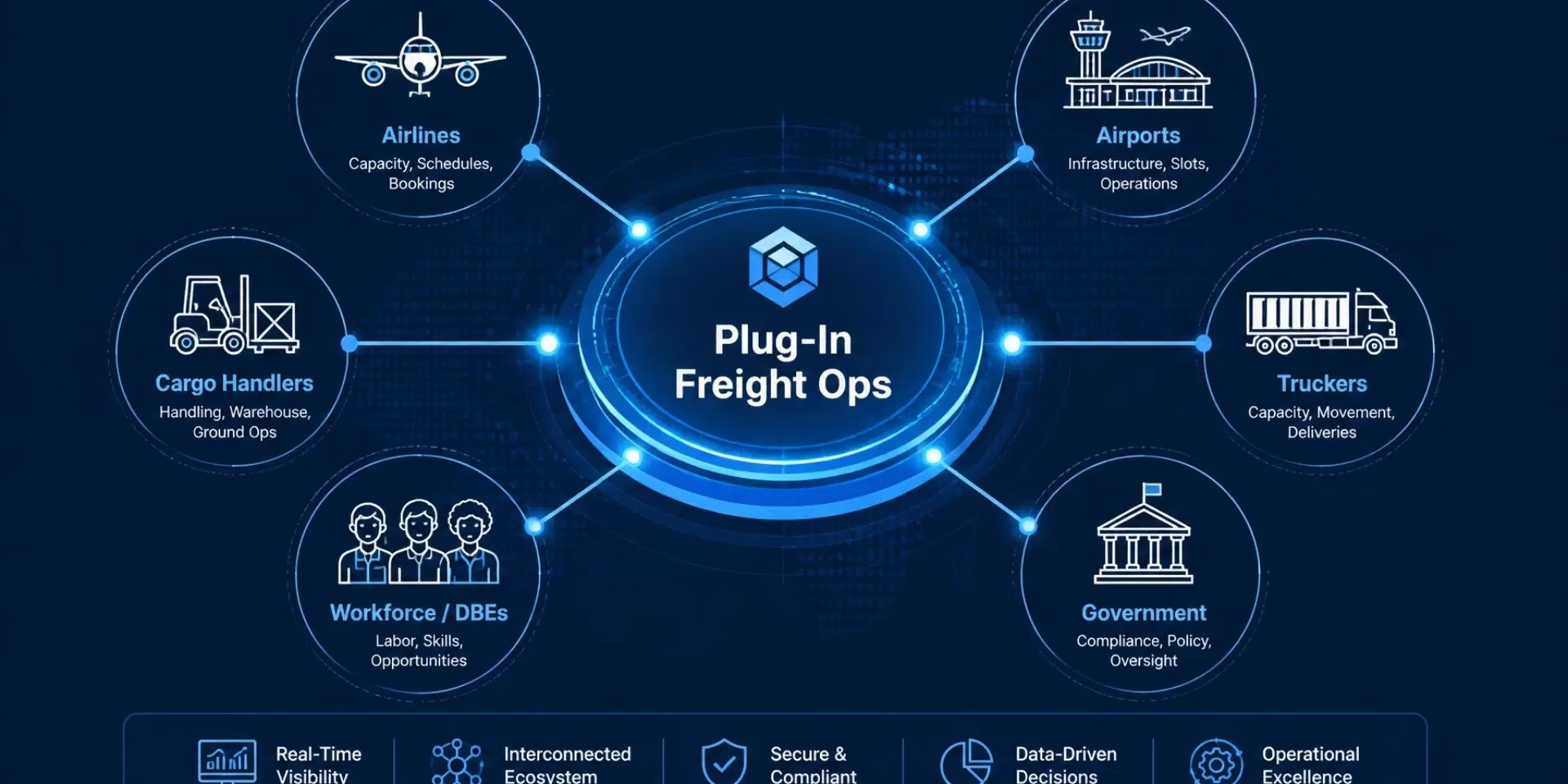
Plug-In Freight Ops™ is designed to coordinate work across fragmented logistics ecosystems, including airlines, GSAs, freight forwarders, trucking providers, cargo handlers, government stakeholders, and partner networks.
For a full reference library of definitions, comparisons and workflows across multi-party freight execution, see the PIFO Knowledge Hub.
It is not positioned as a replacement for every system already in use. Its purpose is to provide structure around the work that crosses those systems.
The Business Case for Coordinated Execution
When multiple freight companies operate from one execution process, the organization gains more than a shared status view.
It gains a clearer basis for:
- Managing handoffs
- Reducing ambiguity
- Assigning accountability
- Responding to exceptions
- Coordinating partner activity
- Reviewing execution performance
- Creating a more consistent customer experience
The central shift is from asking, “What does each company know?” to asking, “How does the network move the shipment forward together?”
Freight execution is a network activity. It should be managed as one.
Call to Action
If your operation depends on multiple freight companies, the first question is not whether every participant has a system.
The first question is whether those participants work from one coordinated execution process.
We typically address this through a focused pilot discussion. We can map a recurring handoff, identify where responsibility becomes unclear, and walk through how a neutral execution layer could apply to your environment.
Explore Plug-In Freight Ops™ or start a partnership conversation.
Sources and further reading
- IATA ONE Record
- IATA ONE Record 2026 Specification
- IATA: How Digitalization and Data Sharing Are Transforming Air Cargo
- IATA Cargo Connect
- Cargo iQ
- IATA Operational Portal
About the author
Michelle DeFronzo is Founder and CEO of ImEx Cargo, a woman-owned logistics and freight-technology company. She builds modular infrastructure that modernizes access and collaboration in operational industries without replacing existing systems.