A shipment’s location is useful information. It is not a plan, an owner, or a completed handoff.
That distinction matters whenever freight moves between organizations. A tracking event can show that cargo has arrived, a dashboard can flag a delay, and a shared record can make information easier to exchange. But none of those, on its own, ensures that the next party knows what to do, accepts responsibility, or confirms the issue is resolved.
Supply chain execution visibility tells stakeholders what can be seen. Multi-stakeholder execution depends on what happens next.
Industry shift
The freight industry has invested in better data exchange and visibility. These capabilities matter: without timely, consistent information, organizations cannot form a reliable picture of shipment status or identify exceptions.
In air cargo, IATA’s ONE Record provides a shared data standard for exchanging shipment information. Its December 2025 survey reported that more than 70% of respondents were aware of ONE Record, nearly 50% indicated readiness, and more than 30 pilots were active worldwide. The survey also found strong demand for more pilots, demonstrations, and implementation guidance.
Those figures describe awareness, readiness, and pilot activity, not the performance of any particular platform. They do, however, show an industry working toward more interoperable information exchange.
A standard can make data more consistent and portable. A visibility platform can help participants see relevant events. Neither necessarily establishes who owns a cross-company action or whether that action is complete. The distinction is not a criticism of standards or tracking tools; it is a boundary around what they are meant to do.
Execution layer
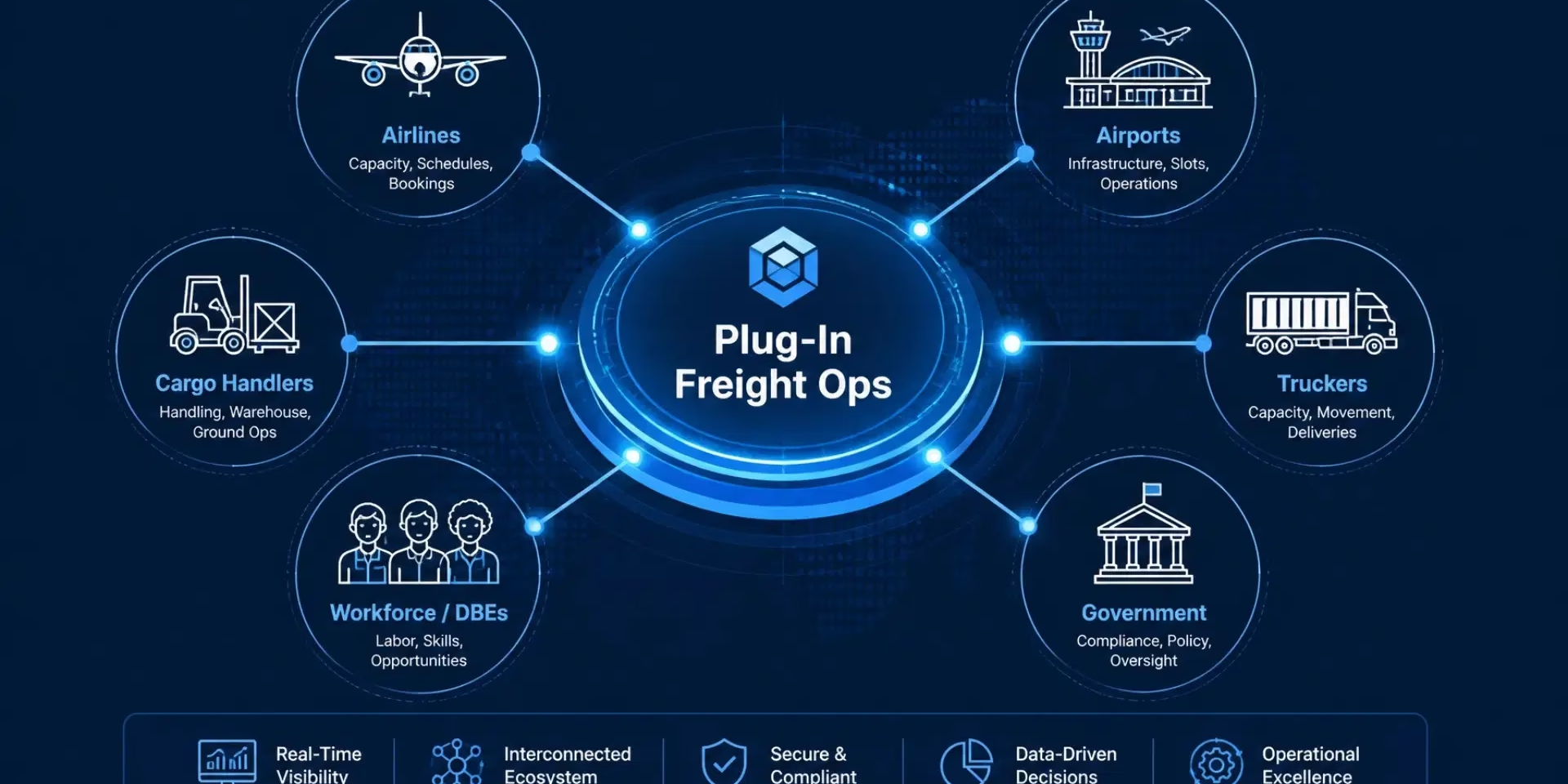
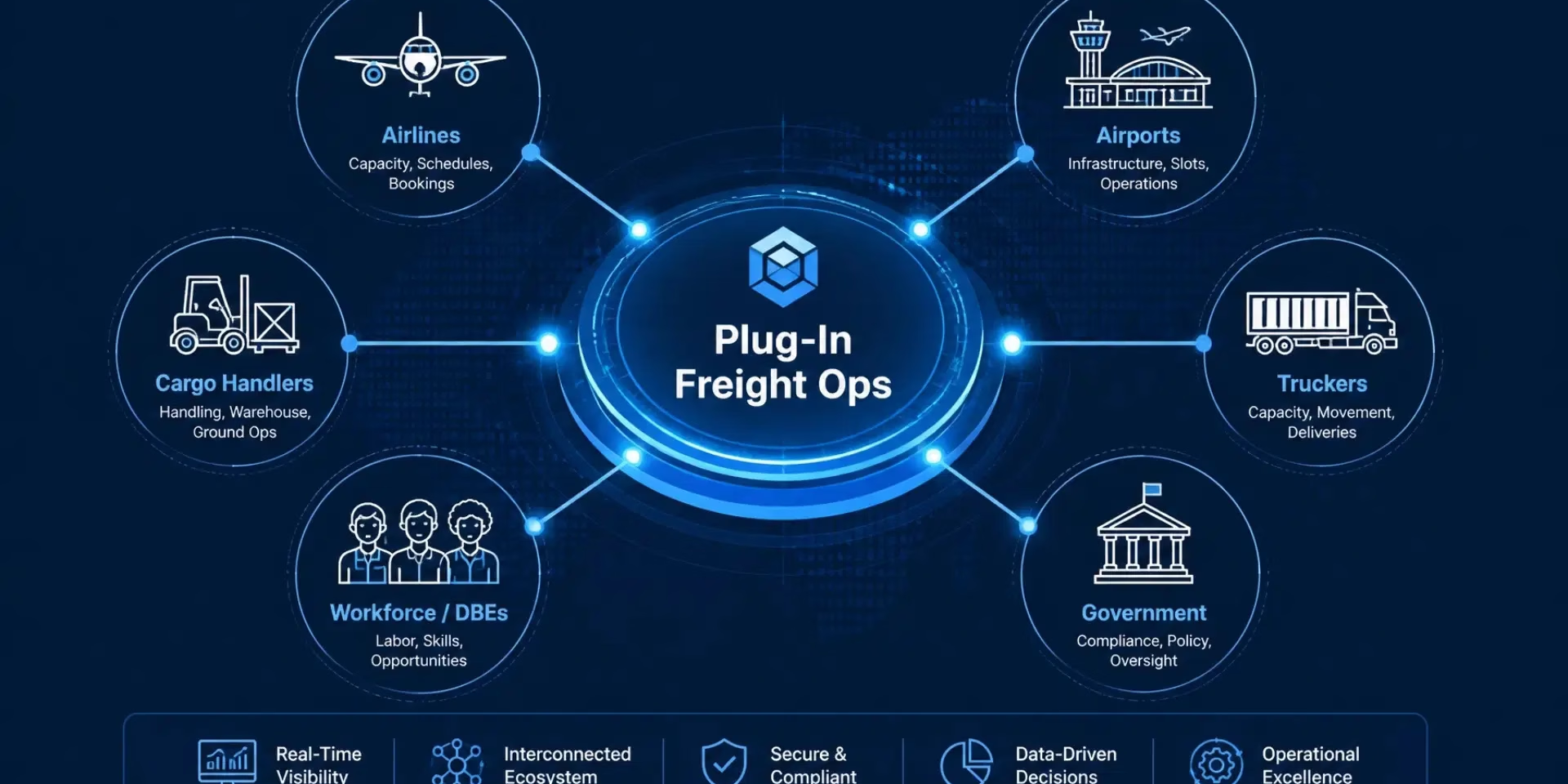
Freight execution crosses organizational boundaries. A shipment may involve a forwarder, airline or GSA, ground handler, trucking provider, airport, and government stakeholders. Each controls part of the movement, and each may work within its own operating environment.
When a plan changes, the important questions are operational:
- Who is responsible for the next action?
- Has the receiving party accepted the handoff?
- What indicates that the issue is resolved?
A location update may reveal that cargo is waiting. It does not necessarily say which party must respond, whether that party has acknowledged the request, or whether the movement is back on track. Visibility creates awareness; coordinated execution connects awareness to responsibility and closure.

This is the distinction at the heart of a freight execution platform or broader digital freight infrastructure: the coordination problem sits between information and action. It is not solved simply by adding another status screen. Nor does a shared data standard itself assign accountability. Standards and visibility platforms remain important complements: they can carry and clarify data that coordinated operations rely on.
Network view
The challenge becomes clearer when the shipment is viewed as a network rather than a single organization’s process. An airline may record one milestone, a handler another, and a trucking provider a third. Each update can be accurate within its own context while the overall handoff remains unresolved.

More distributed commercial relationships make the coordination question especially relevant. Air Cargo Week and Cargo Airports & Airline Services reported Kales leadership’s account that the GSSA share of cargo sales rose from 24% in 2021 to 27% in July 2024 year-to-date. The figure is attributed to Kales leadership and is not independently audited; it should be read as a reported industry indicator, not audited market data. (Air Cargo Week · CAAS)
As responsibility is distributed across more participants, the network needs more than visibility into events. It needs a clear basis for recognizing handoffs and resolving exceptions across organizational boundaries.
Interoperability makes that coordination more practical. IATA’s ONE Record specification is an industry data-sharing foundation, not an accountability mechanism. In the same way, community systems and visibility tools can support shared awareness while remaining complementary to the work of coordinating operational responsibility.
Use cases
Consider a truck arriving at a cargo facility before freight is ready. A status update may explain the mismatch, but it does not by itself align the forwarder, handler, and trucking provider on what happens next.
Or consider documentation that is incomplete at acceptance. The information may be visible to several parties, yet the issue can still linger if ownership is unclear or a handoff goes unacknowledged.
These are not failures of tracking. They are examples of the difference between seeing an exception and coordinating its resolution. The same distinction applies when capacity changes, a cutoff is at risk, or cargo is delayed at a transfer point.

The relevant question is not simply whether an event is visible. It is whether the organizations involved have a shared understanding of who owns the next step and what counts as closure. That is where multi-stakeholder execution becomes a practical operating concern rather than a technology slogan.
Pilot path
A useful industry pilot should test a bounded operational question: can participating organizations improve coordination around a specific handoff or exception? Its purpose should be to examine whether responsibilities are clearer, handoffs are acknowledged, and resolution can be confirmed, not to claim that visibility alone has fixed execution.
Before drawing conclusions, participants should agree on the workflow in scope, the stakeholders involved, and what evidence would indicate progress. They should also identify limitations and cases where coordination remains difficult. Transparent findings are more valuable than broad claims.
This is a practical way to distinguish a promising architecture from a proven operational result. Standards can support interoperability; visibility can improve awareness; a neutral execution layer can address the coordination gap between them. Each has a distinct role. A broader Digital Freight Infrastructure reference library collects these definitions, comparisons and workflows in one place.
As that category develops, Plug-In Freight Ops™ represents ImEx Cargo’s articulation of a digital execution infrastructure layer intended to coordinate across fragmented freight environments. Its place in this discussion is as a logical architectural conclusion, not a claim of independent validation or proven results.
LinkedIn article version
Visibility Is Not Execution: Why Knowing Where Freight Is Doesn't Move It
A shipment’s location is useful information. It is not a plan, an owner, or a completed handoff.
Freight execution crosses organizational boundaries. A shipment may involve a forwarder, airline or GSA, handler, trucking provider, airport, and government stakeholders. Each controls part of the movement, and each may have a different view of the work.
Visibility helps stakeholders see events. It does not necessarily establish who owns the next action, whether a handoff has been accepted, or whether an exception has been resolved.
Industry shift
The industry is building stronger foundations for information exchange. IATA’s ONE Record is a data-sharing standard for air cargo. In its December 2025 survey, IATA reported more than 70% awareness among respondents, nearly 50% indicating readiness, and more than 30 active pilots worldwide. Those figures describe survey responses and pilot activity, not the performance of any specific platform.
Standards matter because they make information exchange more practical. But a data standard does not, by itself, assign responsibility for a cross-company action.
Execution layer
A tracking event may show that cargo has arrived. It may not indicate which party must act, whether that party has acknowledged the handoff, or what confirms resolution.
That is the difference between supply chain execution visibility and coordinated execution. Visibility creates awareness. Coordination connects that awareness to responsibility and closure.
Standards and visibility platforms are complements. They can carry and clarify data without taking on the distinct role of cross-boundary accountability.
Network view
Air cargo operates as a network of organizations, not one unified operating environment. An airline, handler, forwarder, trucker, and government stakeholder may each record a different part of a shipment’s progress. Every update can be accurate while the overall handoff remains unresolved.
Air Cargo Week and CAAS reported Kales leadership’s account that the GSSA share of cargo sales rose from 24% in 2021 to 27% in July 2024 year-to-date. This figure is attributed to Kales leadership and is not independently audited. It is a reported industry indicator, not audited market data.
Use cases
A truck arrives before freight is ready. Documentation is incomplete at acceptance. A capacity change puts a cutoff at risk.
In each case, visibility can reveal an exception. Coordinated execution asks whether the parties know who owns the next step and what constitutes resolution. That distinction applies across the multi-stakeholder freight network.
Pilot path
A useful pilot should examine one bounded operational question: can participating organizations coordinate a specific handoff or exception more clearly? It should establish the stakeholders, the scope, and the evidence needed to evaluate progress, including limitations.
Interoperability makes coordination practical. Visibility helps establish what is happening. A neutral execution layer addresses the coordination gap between information and accountable action.
Plug-In Freight Ops™ is ImEx Cargo’s articulation of this digital freight infrastructure concept: a logical architectural conclusion, not a claim of independent validation or proven results.