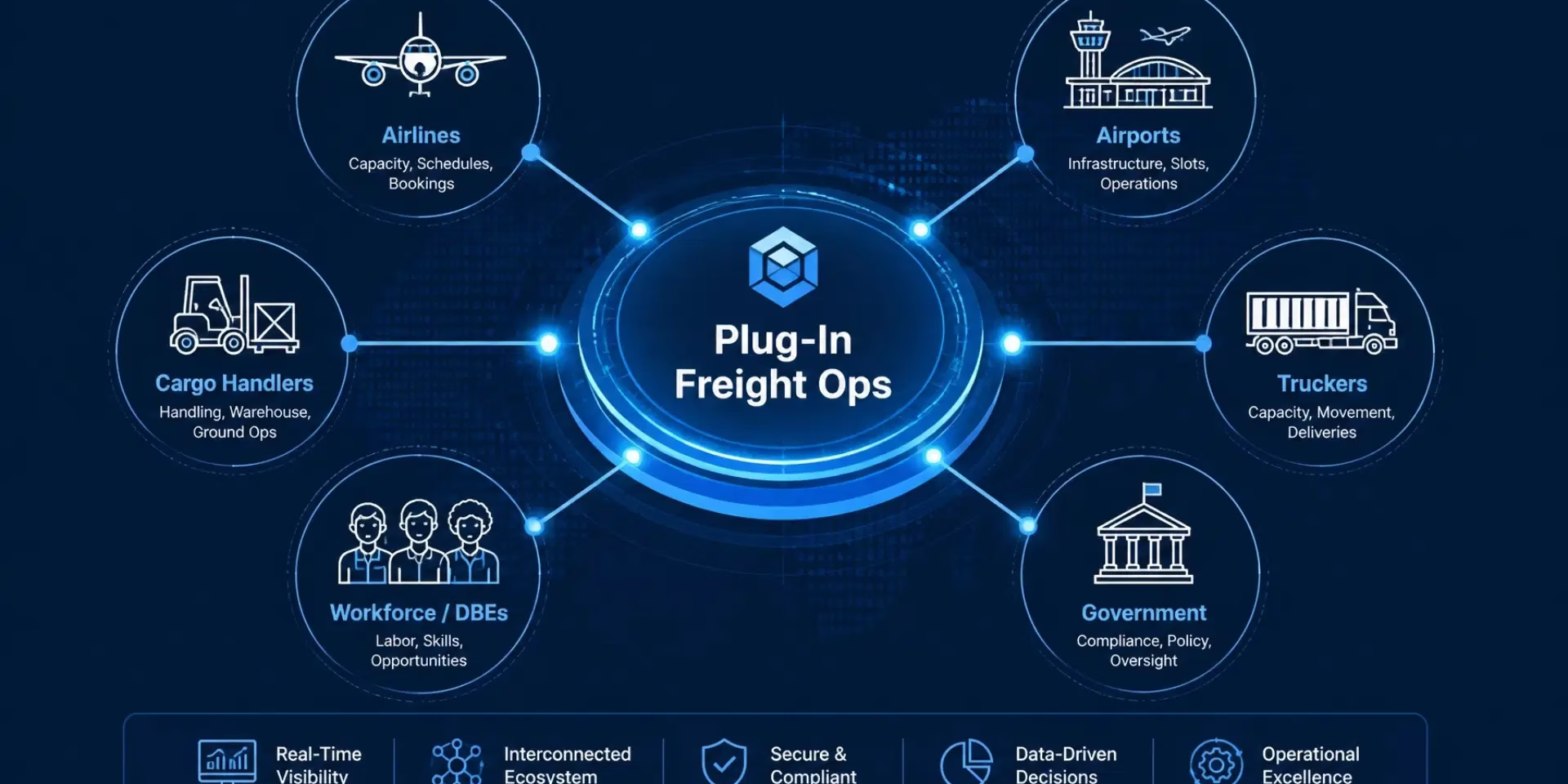
Welcome to the central reference library for Digital Freight Execution Infrastructure: the definitive category resource for logistics professionals, enterprise leaders, and technology architects navigating multi-stakeholder supply chains.
This hub serves as the authoritative repository defining how modern transportation ecosystems coordinate execution, standardize handoffs, and eliminate operational friction across complex, fragmented networks.
Section 1: The Category
Digital Freight Execution Infrastructure is a distinct category of logistics technology. It is not a Transportation Management System (TMS), not a spot-rate freight marketplace, and not a passive visibility or tracking platform.
Instead, it is the neutral digital coordination layer that sits above fragmented systems to manage execution across multi-stakeholder environments.
Rather than forcing organizations into expensive "rip-and-replace" cycles, execution infrastructure connects existing airline systems, ground handling agents (GHAs), freight forwarders, trucking providers, and government authorities into a single, unified operational workflow.
- Explore the foundational definition and capabilities on the Plug-In Freight Ops™ Overview.
- Read the founder's core thesis in The Execution Series Manifesto.
- Review how government and infrastructure logistics are supported through our Government Logistics Infrastructure Support.
Section 2: The Execution Series

An 8-part exploratory series examining why logistics execution breaks down between systems, partners, and handoffs: and how a dedicated coordination layer solves it.
- The Execution Series: I Keep Seeing the Same Conversation : Series Manifesto
The gap between systems. Why visibility isn't execution, and why traditional software stops where real operations begin. - Visibility Is Not Execution
Why tracking dots don't move freight. The fundamental difference between watching a shipment and actively managing its lifecycle. - Integration Is Not Coordination
APIs connect data pipelines, but they do not connect human accountability or exception resolution across organizational boundaries. - Why Logistics Doesn't Need Everyone on the Same System
Debunking the monolithic platform myth. Why forcing thousands of independent partners onto a single proprietary software suite always fails. - What Happens Between Airline Systems, Handler Systems, and Transportation Systems
A deep dive into multi-party handoffs and where freight gets lost in translation between air carriers, GHAs, and truckers. - Why We Didn't Build Another Marketplace
Marketplaces match buyers and sellers. That is a transaction problem, not the operational execution and handoff problem our industry faces. - The Industry Normalized 200 Emails
Quantifying the hidden cost of manual coordination, email chains, phone calls, and spreadsheet reconciliation in daily freight operations. - Why Tribal Knowledge Is an Infrastructure Problem
When your most experienced dispatcher or cargo manager retires, the process shouldn't leave the building with them.
Section 3: The Category Library

A comprehensive reference library answering foundational questions about execution infrastructure, system architecture, and stakeholder coordination.
- Digital Freight Infrastructure vs TMS : How execution infrastructure differs from internal transportation management systems.
- Digital Freight Infrastructure vs Control Tower : Execution management versus passive observation towers.
- Digital Freight Infrastructure vs Visibility Platform : Transitioning from watching shipment milestones to enforcing operational actions.
- Digital Freight Infrastructure vs Digital Freight Marketplace : Orchestrating complex movements versus simple capacity spot-matching.
- Digital Execution Infrastructure vs Integration Middleware : The distinction between technical point-to-point data connectivity and multi-party operational coordination.
- What Is a Freight Execution Layer? : Defining the crucial operational layer situated between enterprise planning and physical delivery.
- What Is Multi-Party Freight Execution? : Coordinating accountability, tasks, and exceptions across independent organizational boundaries.
- Why Freight Handoffs Fail Between Systems : Pinpointing the root causes of execution breakdowns at milestone transitions.
- Airline-to-GHA-to-Trucker Execution : Mapping the precise handoff sequence required for seamless air cargo movements.
- GSA/GSSA Digital Execution Infrastructure : How General Sales Agents leverage execution infrastructure to manage capacity and partner networks.
- Airport Cargo Coordination Infrastructure : Unifying disparate airport hubs, cargo terminals, and ground service networks.
- Customs as Part of Freight Execution : Treating regulatory compliance and customs clearance as active execution handoffs rather than static document silos.
- Digital Infrastructure for DBE Participation : Activating diverse suppliers and disadvantaged business enterprises (DBEs) through structured compliance workflows.
- Freight Asset Execution and Coordination : Tracking physical equipment, containers, and trucking assets across handoff boundaries.
- ONE Record and Execution : How IATA’s data sharing standards integrate into operational execution infrastructure.
- AI + Digital Freight Infrastructure : Why artificial intelligence requires structured execution data and coordinated workflows to deliver actionable value.
- Digital Freight Infrastructure Architecture : Technical blueprint of the coordination layer sitting above core enterprise systems.
- Digital Freight Infrastructure Glossary : Standardized definitions for industry terminology, execution metrics, and coordination concepts.
Section 4: The Category Argument
Logistics technology has evolved through distinct evolutionary stages over the last three decades:
Manual ──> Digital ──> Connected ──> Visible ──> Executable
- Manual: Spreadsheets, phone calls, and paper air waybills.
- Digital: Point solutions, siloed TMS installations, and basic document digitization.
- Connected: EDI links, APIs, and middleware passing raw data between systems.
- Visible: GPS tracking, milestone dashboards, and control towers telling you where a shipment is.
- Executable: The new frontier. This is the territory ImEx Cargo owns. Executable infrastructure doesn't just show you where cargo is: it coordinates who needs to act next, manages the handoff between stakeholders, enforces partner accountability, and resolves exceptions before they cause delays.
Section 5: Structured Data & Schema Implementation
To ensure search engines, enterprise software agents, and AI systems accurately index this category, this Knowledge Hub and all supporting reference pages implement rigorous Schema.org markup.
Structured data schemas utilized across the domain include:
Organization(ImEx Cargo & Plug-In Freight Ops™)SoftwareApplication/ProductPerson(Founder & Leadership representation)Article&TechArticleFAQPageBreadcrumbList