In the high-stakes world of air cargo and global logistics, the cost of a "bad hire" is rarely just the recruiter's fee. It’s the cost of a misrouted pallet, a missed booking window, or a compliance lapse that grounds a critical shipment.
Traditionally, onboarding in logistics has been a slow burn of tribal knowledge and manual shadow-tagging. A new hire sits next to a veteran, watches how they navigate a dozen disconnected systems, and hopes they don't break anything when it's their turn to drive. This "sink or swim" approach isn't just inefficient: it’s a massive operational risk.
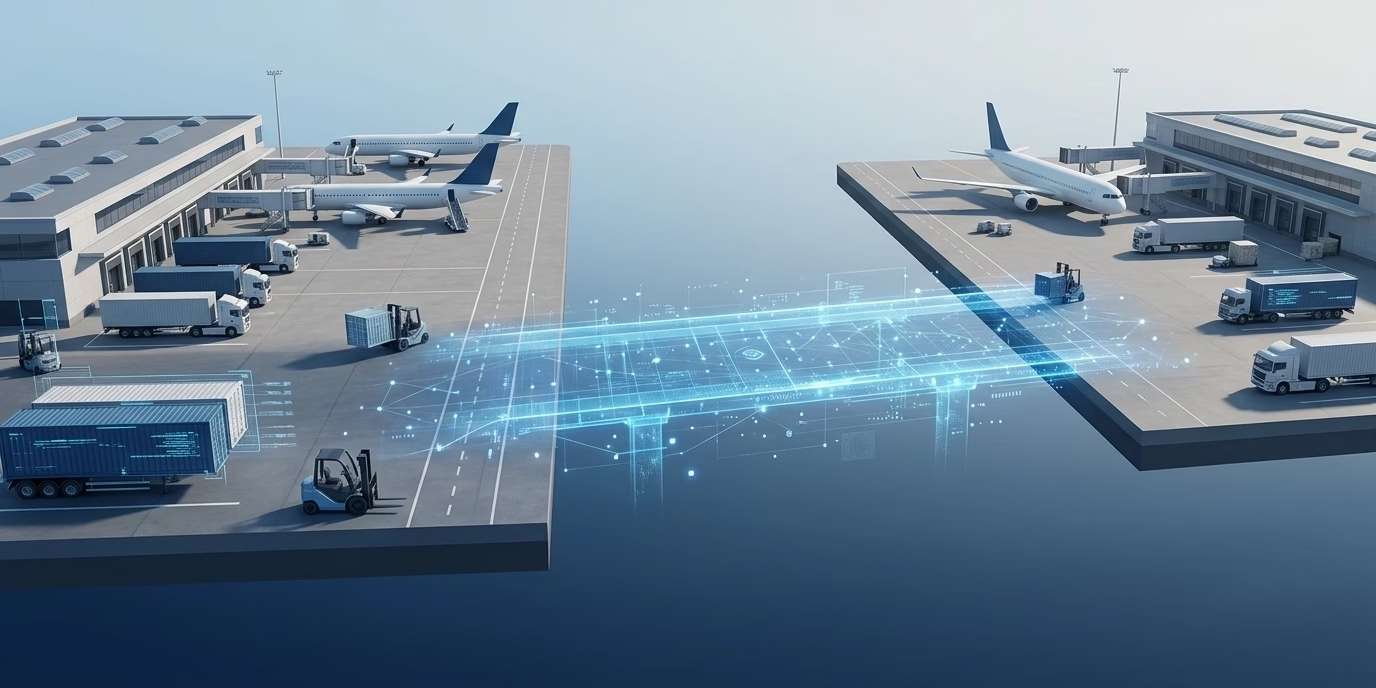
At ImEx Cargo, we’ve reimagined this journey. By utilizing Plug-In Freight Ops™, our digital execution infrastructure, we turn the onboarding process from a months-long marathon into a high-speed sprint. Here is how a unified execution layer creates workforce resilience and gets your team to high performance at warp speed.
The Invisible Barrier: Why Traditional Onboarding Fails
Most logistics organizations operate in a fragmented environment. A new freight coordinator isn't just learning one job; they are learning how to navigate the gaps between airlines, GSAs, trucking providers, and government portals.
When execution breaks down, it’s usually at the handoff. For a new hire, these handoffs are invisible. They don't yet have the "logistics intuition" to know when a shipment is stalling or when a partner hasn't updated their status.
Without a centralized coordination layer, onboarding becomes an exercise in memorizing exceptions. This complexity is exactly what Plug-In Freight Ops™ is designed to eliminate by standardizing the execution environment itself.
1. Standardized Workflows as Operational Guardrails
The fastest way to get a new hire productive is to remove the guesswork. In a traditional setup, "knowing the job" means knowing which spreadsheet to check and which person to call.
With Plug-In Freight Ops™, the workflow is the teacher. The platform standardizes the full shipment lifecycle: Quote → Book → Track → Deliver.

Instead of a new hire trying to remember the specific requirements for a particular airline or a niche DBE partner, those requirements are baked into the execution layer. The system acts as a set of guardrails:
- Structured Handoffs: New staff don't need to wonder who is responsible for the next step. The platform clearly defines the handoff between the freight forwarder and the ground handler.
- Built-in Accountability: Because every stakeholder is connected to the same coordination layer, "who has the ball" is never in question.
- Reduced Cognitive Load: By centralizing visibility, new hires can focus on executing the task rather than navigating the technology.
2. Real-Time Visibility: Learning by Doing (Without the Risk)
Experience is usually the only way to gain "situational awareness" in logistics. Usually, this takes years. However, when a new hire can see the entire ecosystem in a single dashboard, that learning curve collapses.

Our digital execution infrastructure provides real-time visibility that serves as a continuous feedback loop for the employee.
- Immediate Feedback: If a status isn't updated or a document is missing, the platform flags it instantly.
- Contextual Knowledge: Instead of looking at a sterile line of data, the hire sees the shipment within the context of the entire multi-stakeholder flow.
This transparency allows managers to oversee new staff with higher confidence and lower "helicoptering." You aren't checking their work; you are checking the system’s health.
3. From "Hero Culture" to System-Led Execution
A major risk to workforce resilience is the "Single Point of Failure": the one person who knows how everything works. When that person leaves or takes a vacation, the operation slows down.
Plug-In Freight Ops™ shifts the intelligence from the individual to the infrastructure.

By capturing organizational logic within the platform, you ensure that:
- Best Practices are Default: The "right way" to handle a government freight contract or a complex international booking is the only way the system allows.
- Rapid Knowledge Transfer: When a veteran operator leaves, their expertise remains "plugged in" to the workflow, ready for the next person to pick up.
- Scalable Training: You can onboard five people as easily as one because the "training manual" is the software itself.
4. Activating the Ecosystem: DBE and Workforce Pipelines
Logistics isn't just about moving boxes; it's about the people moving them. One of the unique strengths of the Plug-In Freight Ops™ platform is its ability to activate partner ecosystems, including certified DBE (Disadvantaged Business Enterprise) networks and workforce development pipelines. That same model is reflected in ImEx Cargo’s Workforce Innovation Network, which connects execution needs with structured workforce participation.
For organizations managing large-scale infrastructure projects or federal contracts, onboarding isn't just internal: it’s about bringing partners and new talent into the fold. That includes aligning with Workforce Activation Pilots, Employer Partners, and Workforce Development Partnerships that support operational continuity across stakeholders.

The platform provides a unified language for:
- Training Institutions: Connecting directly with talent pipelines to prepare the next generation of logistics professionals through aligned models such as the Academy and broader Workforce Development Partnerships.
- DBE Partners: Providing a structured environment where diverse suppliers can perform at the same level of accountability and visibility as prime contractors within a coordinated Workforce Ecosystem Infrastructure.
- Government Stakeholders: Ensuring that every hire and every partner operation is audit-ready and compliant with project-specific objectives.
Workforce Resilience is a Strategic Choice
In 2026, the competitive advantage in logistics belongs to the organizations that can adapt the fastest. This means being able to scale your workforce up for peak season without sacrificing quality, or pivoting your operations in response to global disruptions without losing weeks to retraining.
Onboarding at "warp speed" isn't about rushing people through orientation. It’s about providing them with a digital infrastructure that makes it nearly impossible to fail.
When you remove the friction of fragmented systems and manual handoffs, you don't just get a faster hire: you get a more resilient organization.
Ready to accelerate your execution?
We typically address these coordination challenges through a focused pilot or a capability walkthrough. If you are struggling with fragmented handoffs or slow time-to-productivity for new staff, let’s map how Plug-In Freight Ops™ can apply to your specific environment. For organizations also evaluating workforce coordination models, you can explore the Workforce Innovation Network, Workforce Activation Pilots, and our Employer Partners ecosystem.
Contact ImEx Cargo to schedule a walkthrough of our digital execution infrastructure.