Most organizations already have a Transportation Management System (TMS) in place.
Yet, even with high-end software, shipments often still require manual coordination across airlines, freight forwarders, trucking companies, warehouses, and government agencies. Operations teams find themselves trapped in endless email chains, frantic phone calls, and manual spreadsheet updates just to move a single piece of freight.
The reason is simple: A TMS is designed to manage transportation inside one organization.
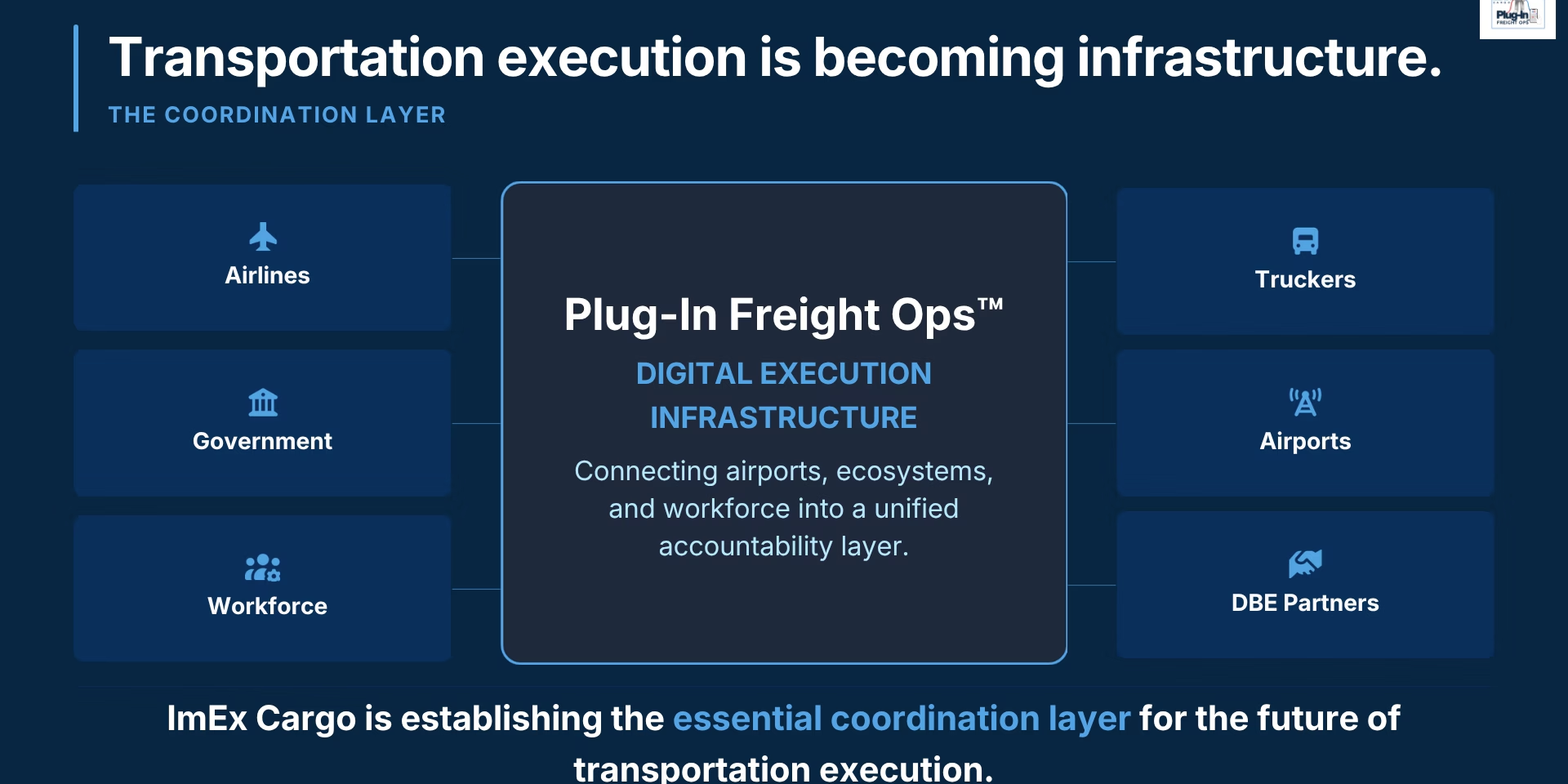
Plug-In Freight Ops™ is designed to coordinate execution across the entire freight ecosystem. It doesn't replace your internal system; it acts as the digital freight infrastructure that sits above it to connect every stakeholder in the shipment lifecycle.
What is a Traditional TMS?
A Transportation Management System (TMS) is essentially a "system of record" for an organization’s internal freight movements. It is a vital tool for transportation planning, carrier selection, freight rating, dispatching, and auditing.
A TMS works exceptionally well when you are looking inward, optimizing your own routes, choosing your preferred carriers, and tracking your specific shipment records. However, because these systems were built for internal enterprise use, they often become silos. They struggle to communicate with the myriad of external systems used by partners, leading to "visibility gaps" the moment freight leaves your immediate control.
What is Plug-In Freight Ops?
Plug-In Freight Ops™ is Digital Freight Execution Infrastructure.
Instead of being a system of record for one company, it functions as a system of coordination for all companies involved in a project. Rather than replacing your existing TMS, ERP, or WMS, it creates a unified coordination layer above them.
Think of it as a logistics orchestration layer. It connects the disparate systems of airlines, GSAs, trucking companies, and airports into a single, structured workflow. This allows for real-time visibility and, more importantly, structured handoffs and partner accountability that a traditional TMS cannot provide.

Side-by-Side: The Core Differences
When evaluating your technology stack, it is helpful to understand where a TMS ends and where a freight execution platform begins.
| Capability | Traditional TMS | Plug-In Freight Ops™ |
|---|---|---|
| Transportation Planning | ✓ (Core Focus) | Works alongside internal plans |
| Shipment Execution | Limited to internal steps | Enterprise-wide execution |
| Cross-Company Coordination | Limited / Manual | ✓ (Primary Purpose) |
| Multi-Party Workflows | Limited | ✓ |
| Partner Collaboration | Partial (via portals) | ✓ (Real-time ecosystem) |
| Workflow Orchestration | Limited | ✓ |
| API Coordination | Partial | ✓ |
| Digital Handoffs | Limited | ✓ |
| Workforce Coordination | No | ✓ |
| Existing System Replacement | Often required | No |
| Ecosystem Collaboration | Limited | ✓ |
Understanding the Technology Stack
In a modern, interconnected supply chain, systems must be layered. Plug-In Freight Ops™ serves as the neutral coordination infrastructure that bridges the gap between your internal data and your external partners.
The Stack Architecture:
- ERP (Finance, Inventory, Master Data)
- TMS / WMS / CRM (Internal execution and shipment records)
- Partner Systems (Your carrier's or vendor's internal software)
- Plug-In Freight Ops™ (The coordination layer connecting everyone)
- Connected Ecosystem (Airlines, Truckers, DBEs, Government)

By positioning the platform as a cargo execution infrastructure, organizations can maintain their existing technology investments while finally achieving the end-to-end visibility and control they’ve been seeking.
When Is a TMS Enough?
A traditional TMS may be sufficient for your needs if:
- Your transportation is managed entirely by an internal fleet.
- Your partner collaboration is minimal or restricted to a few stable carriers.
- Your workflows are linear and simple (Point A to Point B).
- You do not have a mandate for cross-enterprise accountability or DBE activation.
When Do Organizations Need More?
As operations scale and complexity increases: particularly in air cargo, large-scale infrastructure projects, or government-led logistics: execution often breaks down at the handoff points.
You likely need a cargo execution command center if you are facing:
- Disconnected Systems: You have to log into five different portals to see one shipment's status.
- Manual Effort: Your team spends hours "status chasing" via email and phone.
- Inconsistent Visibility: You know when a truck left, but not when the airline actually processed the cargo.
- Partner Accountability: There is no "single source of truth" for when a delay happened or who was responsible.
Plug-In Freight Ops™ addresses these gaps by standardizing the execution lifecycle: from quote to booking to tracking and delivery: across every entity involved.

Frequently Asked Questions
Does Plug-In Freight Ops replace our TMS?
No. Plug-In Freight Ops™ is designed to complement existing systems. It acts as an infrastructure layer that coordinates data and workflows across multiple different TMS and ERP systems used by various stakeholders.
Can we keep our current software?
Yes. The platform is built on a "plug-in" philosophy. It integrates with your current technology stack, allowing you to maximize the value of your existing investments while adding the coordination capabilities you currently lack.
Who benefits from this coordination layer?
Our platform is designed for the entire logistics ecosystem, including:
- Airlines & GSAs: To manage capacity and partner coordination.
- Freight Forwarders: To gain true visibility across multi-party flows.
- Airports & Hubs: To coordinate multi-entity ground operations.
- Government & Infrastructure: To manage complex programs with governed logistics orchestration.
- Workforce Partners: To integrate talent pipelines directly into the execution flow.

Moving Toward a System of Coordination
The future of logistics isn't about finding a single "all-in-one" software that forces everyone to use the same interface. It is about building a logistics operating system that allows different organizations to work together seamlessly, regardless of what internal tools they use.
At ImEx Cargo, we focus on the execution that happens between organizations. By providing a neutral, infrastructure-level layer of control, we help our partners reduce risk, eliminate delays, and ensure that every stakeholder is held accountable for their role in the shipment lifecycle.
Ready to see how Plug-In Freight Ops™ fits into your technology ecosystem?
We typically address these challenges through a focused pilot program or a capability walkthrough. Schedule a strategy discussion to explore how digital freight execution infrastructure can complement your current operations and close the gaps in your supply chain execution.