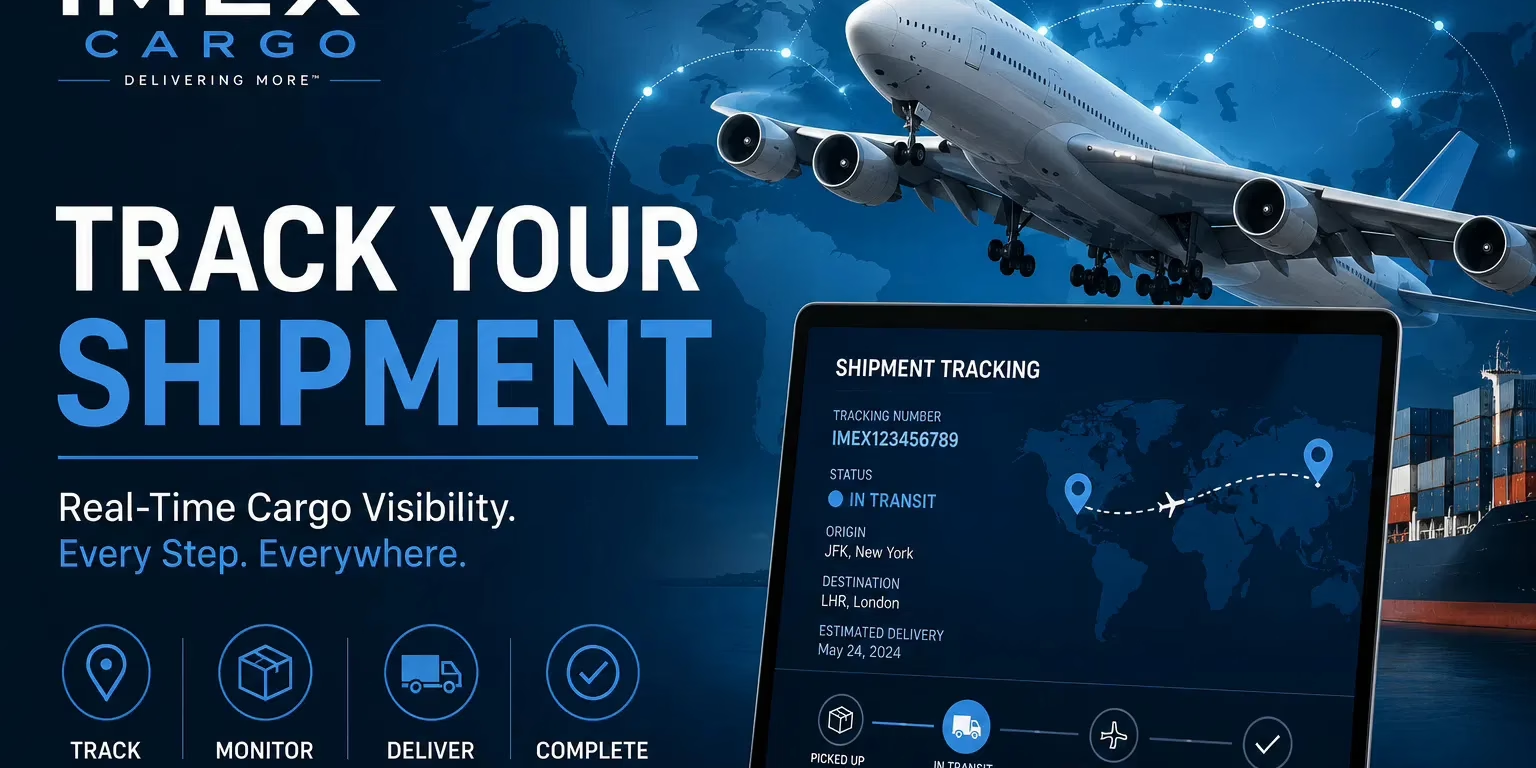
For decades, the air cargo industry has operated on a "ship and pray" model. Even with the advent of real-time tracking, stakeholders are often left watching a delay happen in slow motion, unable to intervene until the damage is done. The limitation isn't a lack of data; it’s a lack of execution intelligence.
As logistics enters a new era of digital execution infrastructure, a new capability is emerging to bridge the gap between knowing where a shipment is and knowing how to move it forward: Cargo Execution Intelligence (CEI).
What is Cargo Execution Intelligence?
Cargo Execution Intelligence is the application of execution data, performance tracking, and workflow intelligence to optimize multi-party cargo operations in real-time.
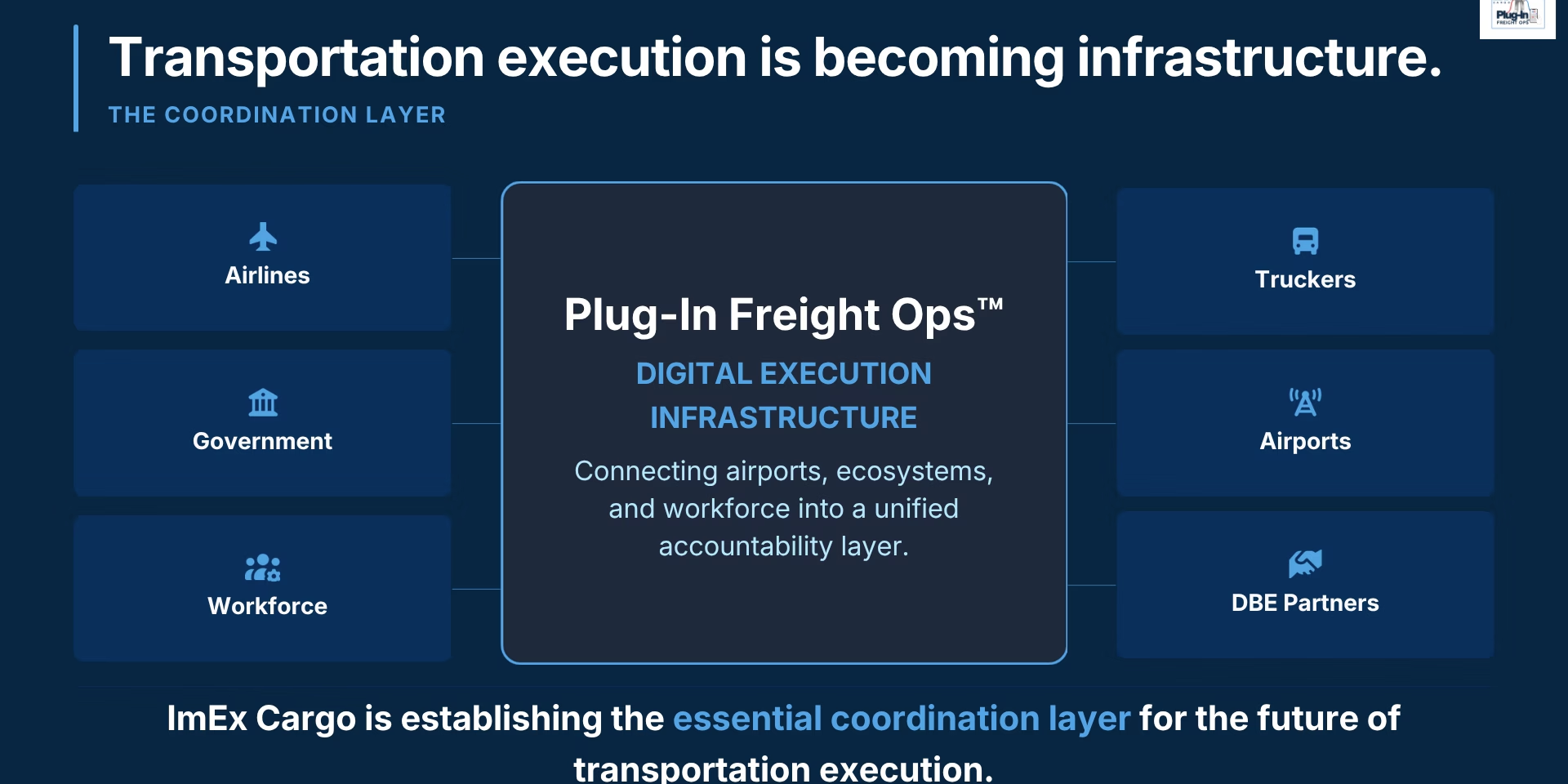
Unlike traditional logistics software that focuses on recording transactions (TMS) or displaying dots on a map (Visibility Platforms), CEI is designed to understand the mechanics of execution. It functions as the reasoning layer within a freight execution platform, interpreting signals from various stakeholders: airlines, GSAs, truckers, and ground handlers: to ensure every handoff occurs exactly as planned.
At its core, CEI answers three critical questions that visibility alone cannot:
- Who owns the next move? (Accountability)
- Is this move happening according to the standard? (Compliance)
- What will break in two hours if we don't act now? (Predictive Execution)

Beyond Visibility: From "Where?" to "What's Next?"
The industry has spent billions on "visibility." We can see where a plane is. We can see where a truck is. But visibility is a passive record of history. It tells you that a shipment is late, but it doesn't tell you why or how to prevent the next one from following suit.
Cargo Execution Intelligence moves the needle from visibility to logistics orchestration.
The Visibility Trap
In a visibility-only environment, data is fragmented. The airline has their data, the trucker has theirs, and the forwarder is stuck in the middle trying to reconcile the two via email. When a delay occurs at the warehouse dock, it’s a "black hole" until the next status update is manually entered.
The Intelligence Advantage
In an environment powered by Cargo Execution Intelligence, the platform recognizes the governed logistics orchestration required for a successful move. If a truck hasn't checked into a geofence thirty minutes before a scheduled handoff, the intelligence layer doesn't just send an "alert": it triggers a workflow adjustment. It might automatically notify the ground handler to re-sequence the loading priority or alert the GSA to a potential booking risk.
Data Sources: The DNA of Execution
CEI doesn't rely on generic "milestones." It feeds on execution data: the granular, high-fidelity signals generated during the actual movement of freight.
- Structured Handoffs: Digital "handshakes" between parties (e.g., a trucker's digital signature at an airport warehouse) that verify custody and condition.
- Partner Performance Metrics: Real-time tracking of how long a specific carrier takes to clear customs or how often a ground handler meets the "ready-for-carriage" window.
- Workflow Completion Rates: Measuring the delta between the planned execution time and the actual completion of individual tasks within the shipment lifecycle.
- Ecosystem Signals: Data from workforce pipelines and DBE partners, ensuring that compliance and operational readiness are factored into the execution plan.

Intelligence Applications: Putting Data to Work
Cargo Execution Intelligence is only as valuable as the outcomes it drives. By applying intelligence to the cargo execution infrastructure, organizations can unlock several key capabilities:
1. Bottleneck Identification
CEI analyzes patterns across thousands of shipments to identify "invisible" bottlenecks. For example, it might find that a specific airport terminal consistently experiences a four-hour lag in document processing every Tuesday morning. Managers can then reroute freight or adjust staffing proactively.
2. Partner Accountability Scoring
Traditional carrier scorecards are often subjective and backward-looking. CEI provides real-time accountability. Because every handoff is captured in a structured workflow, the platform can score partners based on their actual execution performance: not just their price.
3. Predictive Execution Insights
By reasoning over operational data, CEI can predict failures before they happen. If a shipment's "completion velocity" slows down in the early stages of the journey, the system flags it as a high-risk booking, allowing the GSA or airline to intervene while there is still time to recover.

How It Differs from Business Intelligence (BI)
It is common to confuse Execution Intelligence with traditional Business Intelligence. However, the two serve fundamentally different purposes:
| Feature | Business Intelligence (BI) | Cargo Execution Intelligence (CEI) |
|---|---|---|
| Focus | Historical patterns and trends | Real-time execution and orchestration |
| Primary Goal | Reporting and strategy | Action and intervention |
| Data Type | Aggregated, static datasets | Live, event-driven execution signals |
| Output | Dashboards and PDF reports | Automated triggers and workflow alerts |
| Time Horizon | Looking backward (Last month/quarter) | Looking at the now (Next 2-6 hours) |
BI tells you that you lost 5% of your margin last month due to delays. CEI tells you that you are about to lose your margin on this shipment, and here is who needs to move to save it.
Why Air Cargo Needs It: The Fragmentation Problem
The air cargo industry is uniquely fragmented. A single shipment may pass through the hands of an airline, a GSA, a freight forwarder, two trucking companies, a ground handler, and customs officials.
In this multi-stakeholder execution environment, information doesn't just get delayed: it gets distorted. Every handoff is a potential point of failure. Without a centralized "brain" to coordinate these movements, the industry relies on manual heroism to get things done.
Cargo Execution Intelligence provides the multi-party freight coordination necessary to manage this complexity. By standardizing the "execution language" across all parties, it ensures that an airline in Dubai and a trucker in Boston are operating from the same playbook, governed by the same intelligence.

The Path Toward Intelligent Execution
Cargo Execution Intelligence is not a replacement for your existing systems. It is the intelligence layer that sits above them, making your TMS, your ERP, and your tracking tools work harder for you.
As the industry moves away from manual coordination and toward autonomous orchestration, CEI will become the standard for any organization that treats logistics not just as a cost center, but as a competitive infrastructure.
At ImEx Cargo, we are building this intelligence into the very fabric of our Plug-In Freight Ops™ platform. We aren't just helping you see your cargo; we are helping you execute the perfect move, every time.
Are you ready to move beyond visibility?
We typically address this through a focused pilot program designed to map execution intelligence to your specific operational environment. Contact our team today to begin a capability walkthrough.