Article #3 of The Digital Freight Infrastructure Journal
Every industry that underwent fundamental digital transformation eventually arrived at a defining inflection point: the realization that scattered applications are not enough. Building disconnected software tools: whether for accounting, customer relations, or inventory tracking: ultimately creates a maze of silos. To unify them, industries must build infrastructure. A foundational layer that sits beneath applications to standardize how work happens, how data flows, and how disparate parties interact.
Logistics is at that exact inflection point today.
Over the past two decades, the freight and transportation sector has deployed an array of specialized software: Transportation Management Systems (TMS), Warehouse Management Systems (WMS), customs clearance portals, carrier tracking feeds, and procurement tools. Yet, despite having more software than ever, operational friction persists. The missing piece is not another application. It is the foundational infrastructure that connects them operationally.
Defining the Category: The Execution Coordination Layer
Digital Freight Infrastructure represents a new category of enterprise technology. It is not an end-user application or a point solution; it is an execution coordination layer.
Operating above individual systems, this layer connects stakeholders not merely through raw data integration, but through structured workflows. It assigns operational responsibility, triggers timed actions, tracks handoffs in real time, and measures performance across distinct organizational boundaries.
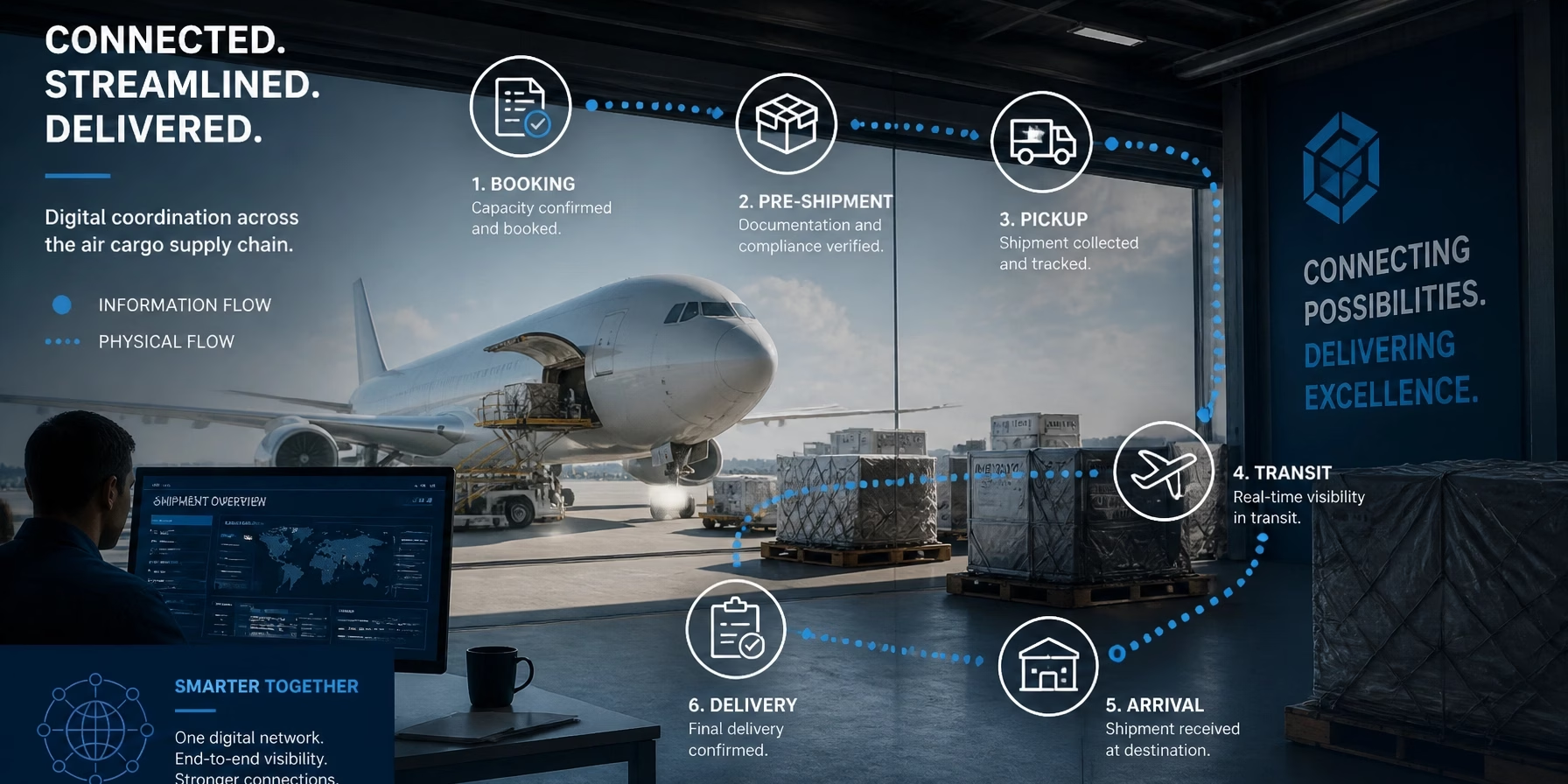
In multi-stakeholder environments: where a single air cargo shipment or infrastructure project involves airlines, ground handlers, freight forwarders, trucking providers, customs authorities, and project owners: digital freight infrastructure provides the connective tissue. It transforms a fragmented chain of phone calls, emails, and isolated portal entries into a unified, audit-ready operational flow.

What Digital Freight Infrastructure Is Not
To understand the scope and precision of this category, it is vital to distinguish digital freight infrastructure from adjacent software categories:
- Not a TMS: A Transportation Management Systems optimizes transportation planning, rating, and carrier selection within a single organization. Infrastructure coordinates execution across multiple independent organizations whose TMS platforms cannot talk to one another.
- Not a Visibility Platform: Visibility tools tell you where freight is located at a given moment. Infrastructure coordinates what happens next, managing the operational actions, approvals, and handoffs required to keep freight moving.
- Not a Marketplace: Marketplaces exist to match supply with demand (spot rates, capacity auctions). Infrastructure manages execution after the match has been made, ensuring the transaction is fulfilled reliably across every participating entity.
- Not Integration Middleware: Middleware connects systems at a technical level by passing data back and forth. Infrastructure connects stakeholders at an operational level, defining workflows, rules, accountability, and sequence across human and digital participants.
The Core Function: Continuous Operational Orchestration
At its operational core, digital freight infrastructure continuously answers three fundamental questions for every movement or project milestone:
- What needs to happen next?
- Who owns the responsibility?
- Has it been executed correctly?
Rather than replacing the legacy systems, enterprise platforms, or carrier portals that organizations already rely on, infrastructure sits above them to orchestrate the work. It takes inputs from disparate databases, harmonizes them into a single timeline, and enforces accountability at every handoff point.
For logistics executives navigating complex air cargo operations or large-scale infrastructure supply chains, this means moving from reactive firefighting to predictable, standardized execution.

Why Now: The Breaking Point of Industry Fragmentation
Fragmentation in global logistics has reached a breaking point. Consider a typical international air cargo shipment: it passes through the hands of shippers, forwarders, airline carriers, ground handlers, ramp operators, trucking companies, and regulatory bodies. Each entity operates on proprietary software, legacy terminal systems, or manual ledgers.
Handoffs between these organizations are routinely managed through unstructured channels: emails, phone calls, and manual re-keying of data. As cargo volumes grow, regulatory requirements tighten, and supply chain complexity increases, the cost of this fragmentation becomes unsustainable.
Delays multiply, data discrepancies lead to compliance risks, and accountability vanishes in the "dead zones" between handoffs. Organizations can no longer scale by simply adding more headcount to manage communications. They require structural standardization.
The Infrastructure Parallel
The evolution mirrors the transformation of enterprise computing. Before cloud infrastructure standardized computing, networking, and storage into unified services, every company built its own isolated server rooms and custom network scripts. The arrival of cloud infrastructure didn't destroy enterprise applications; it provided the reliable, scalable foundation upon which modern software could run without friction.
Similarly, digital freight execution infrastructure sits beneath logistics applications to standardize execution. It is the architectural layer that makes multi-party fragmentation manageable, turning chaotic networks into disciplined, measurable ecosystems.

Conclusion
The organizations that build upon and adopt digital freight infrastructure will define the next era of global logistics and supply chain management. By establishing a unified cargo execution infrastructure and prioritizing freight execution layer orchestration, enterprises can eliminate operational blind spots and achieve true audit-ready control.
The question facing industry leaders today is not whether digital freight infrastructure will become the standard for complex operations: it is who will adopt it first, and what competitive advantage they will secure in the process.
About the Author
Michelle DeFronzo is Founder and CEO of ImEx Cargo and creator of Plug-In Freight Ops™, a Digital Freight Infrastructure initiative focused on improving execution coordination across fragmented cargo ecosystems. Drawing on more than 30 years of operational experience in airline cargo, GSA/GSSA operations, freight forwarding, trucking, and government logistics, her work explores how digital execution infrastructure can connect organizations, systems, assets, and handoffs without replacing existing technology.