For prime contractors and logistics providers, winning a federal contract is the beginning of a complex execution phase where the stakes are higher than just "on-time delivery." With the implementation of the Cybersecurity Maturity Model Certification (CMMC) and NIST 800-171 standards, the handling of Controlled Unclassified Information (CUI) has become a non-negotiable prerequisite for doing business with the Department of Defense (DoD) and other federal agencies.
In the world of freight and infrastructure, CUI isn't just data on a server: it is the flight schedule of sensitive equipment, the precise GPS coordinates of a delivery, and the technical specifications of the cargo being moved.
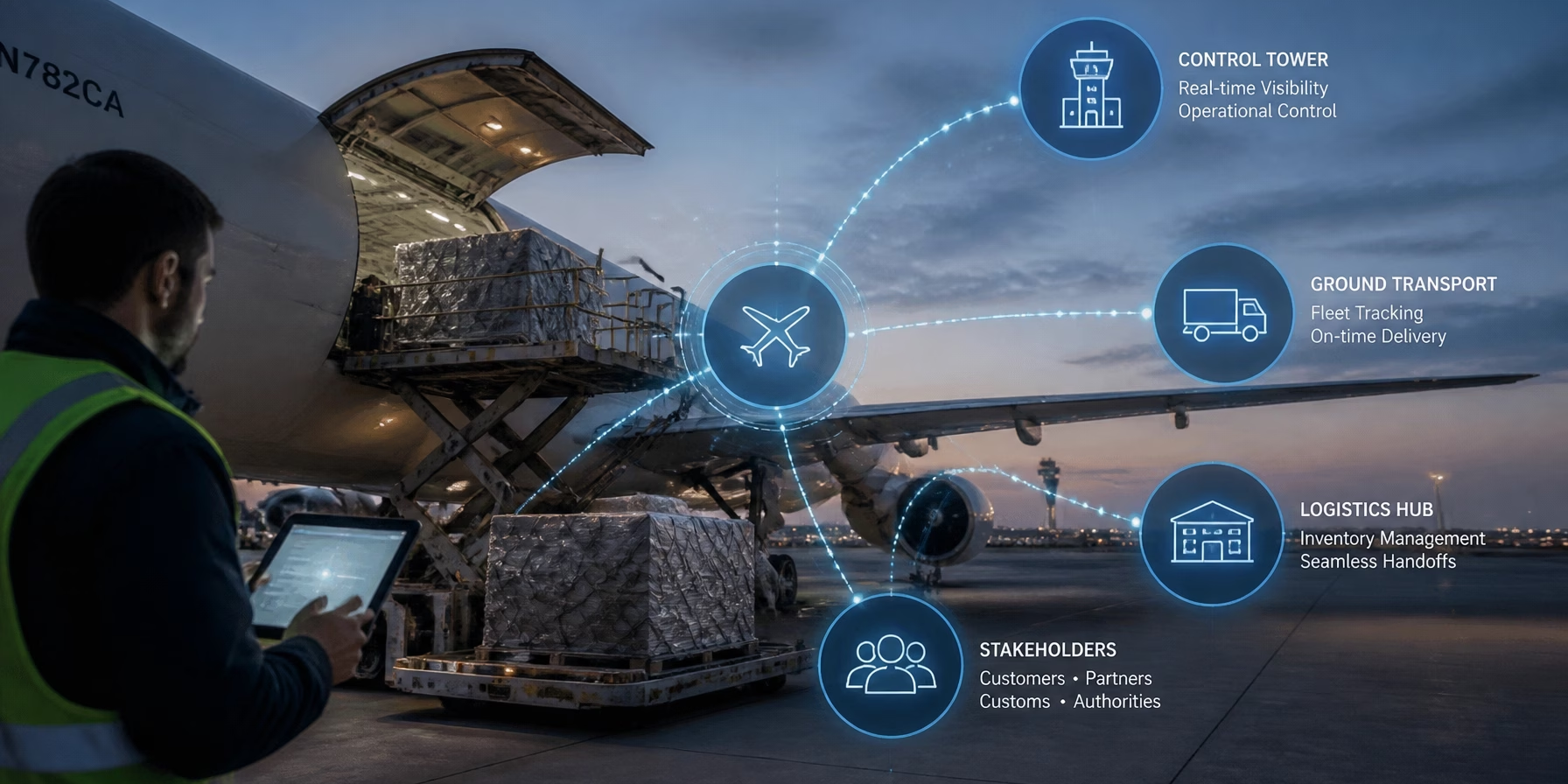
Where execution breaks down is often where compliance fails. In government logistics, that failure usually appears across fragmented cargo ecosystems where carriers, forwarders, GSAs, truckers, and government stakeholders all touch the same shipment data without a shared execution standard. If your operation relies on disconnected systems without a digital freight infrastructure layer to govern execution, visibility, and control, you are likely making one of these seven critical mistakes that put your federal contracts at risk.
1. Underestimating the Scope of Your CUI Boundary
Many contractors mistakenly believe CUI only exists within their primary internal database. In reality, CUI flows through every handoff in the shipment lifecycle. It’s in the emails sent to trucking providers, the manifests shared with airlines, and the digital backups stored by third-party logistics firms.
Failing to map these information flows accurately creates "blind spots" that an auditor will immediately flag. If a logistics partner in your chain is handling shipment details without proper oversight, your entire organization is technically out of compliance.
2. Treating CMMC as a One-Time "IT Problem"
Compliance is often treated as a technical checkbox rather than an operational standard. Documentation gaps are the #1 reason for failed federal audits. Organizations frequently implement security controls but fail to maintain an updated System Security Plan (SSP) or provide evidence of consistent execution.
In government logistics, CUI compliance is not just an IT issue. It is an execution issue that lives inside the digital freight infrastructure layer where partners exchange shipment data, approvals, status updates, and delivery instructions. That is where execution accountability, secure handoffs, and exception management have to be enforced.
For logistics leaders, this means you need more than a firewall or a secure file repository. You need an audit-ready record of how execution moved across stakeholders from quote to booking to tracking to delivery. That is the difference between simply storing data in a TMS and actively coordinating secure execution across multi-party environments.

3. Mixing CUI with Generic Business Data
Storing CUI: such as sensitive shipment schedules: alongside general project files is a high-risk practice. When data isn't partitioned, it becomes impossible to enforce "least-privilege" access. This increases the risk of unintentional exposure and makes the auditing process significantly more difficult.
At ImEx Cargo, we address this through Plug-In Freight Ops™, a digital freight infrastructure layer that sits above disparate systems to standardize execution. Rather than relying on each partner's TMS, inbox, or spreadsheet to control sensitive activity, the platform manages execution across the workflow itself. That means CUI is governed through structured coordination, secure handoffs, role-based visibility, and exception management throughout the shipment lifecycle.
This approach strengthens execution accountability by keeping sensitive data inside a controlled coordination layer instead of letting it fragment across separate tools and organizations. The result is more secure multi-party execution during booking, tracking, and delivery.
4. Overlooking Physical Security in Transit
While most compliance efforts focus on cybersecurity, NIST 800-171 explicitly requires physical protection (PE domain). In logistics, this is where operational risk becomes a compliance risk. If a container is tampered with, custody changes are not documented, or location data is exposed during transit, that can compromise CUI.
Within Plug-In Freight Ops™, physical security can be incorporated into the broader execution framework through connected tracking, status validation, and structured custody controls. This supports:
- Real-time physical integrity monitoring: Sensor-driven awareness for movement, shock, light, or route deviation.
- Documented custody events: Clear records of who handled the shipment, when, and at which handoff point.
- Continuous execution visibility: A persistent audit trail across multimodal workflow steps so the data trail remains intact during transit.
5. Fragmented Visibility Across the Supply Chain
Federal contracts often involve a "prime" contractor managing a web of subcontractors, airlines, GSAs, and trucking providers. When these stakeholders operate in silos, there is no single source of truth. This is one of the core visibility challenges in regulated environments, especially when government logistics execution depends on timely data exchange across separate organizations.
Fragmentation leads to manual handoffs (emails, phone calls, spreadsheets), all of which are insecure and non-compliant ways to handle CUI. A TMS may record a shipment transaction, but it does not solve cross-party coordination or enforce secure execution between stakeholders. Without a centralized execution layer, you cannot prove to an auditor that the data remained secure throughout the multi-party journey.
Compliance, in this context, is not just a legal requirement. It is an infrastructure-grade control model for managing execution accountability, handoffs, and exception management across the network. That is what makes every transfer traceable, structured, and defensible.
6. Failing to Vet the Broader Ecosystem
Your compliance is only as strong as your weakest partner. Federal contracts often require the participation of certified DBE (Disadvantaged Business Enterprises) and diverse suppliers. However, many prime contractors fail to verify the compliance posture of these smaller partners.
ImEx Cargo bridges this gap by activating a pre-vetted DBE network within our Plug-In Freight Ops™ environment. We provide the coordination layer that allows diverse suppliers to participate in federal projects while adhering to the same rigorous execution and security standards as the prime contractor.

7. The Absence of a Unified Execution Layer
The most common mistake is trying to manage complex federal logistics using legacy systems that weren't built for multi-stakeholder coordination. These systems don't "talk" to each other, leading to data leaks and a lack of accountability. This is where compliance breaks down in government logistics: disconnected systems weaken coordination, obscure handoffs, and slow response when exceptions occur.
Instead of replacing your existing systems, you need a layer that sits above them to standardize execution. This is the core of our City, State, and Federal Partnering Opportunities. Plug-In Freight Ops™ operates as digital freight infrastructure above disparate systems, managing execution across the full lifecycle while keeping sensitive data secure during multi-party handoffs. Every partner works through a structured coordination model. Every action supports execution accountability. Every exception is managed inside an audit-ready environment.

Protecting Your Federal Revenue
The deadline for CMMC Level 2 certification is rapidly approaching. By late 2025, contractors without the required certification will be ineligible to bid on DoD contracts. More importantly, the False Claims Act means that misrepresenting your compliance status can lead to multi-million dollar settlements.
Protecting your federal contracts requires a shift from "generic shipping" to infrastructure-grade execution control. You need visibility that isn't just about knowing where a truck is, but about proving that the information used to move that truck was handled securely across every stakeholder interaction. In government logistics, that means treating compliance as part of the execution layer itself: where handoffs are structured, exception management is controlled, and accountability is preserved across the workflow.
How ImEx Cargo De-Risks Your Operation
ImEx Cargo operates Plug-In Freight Ops™, a digital freight infrastructure layer designed specifically for these fragmented, high-stakes environments. We coordinate the ecosystem of airlines, truckers, forwarders, and government stakeholders inside a single execution framework that sits above disparate systems.
Our platform provides:
- Execution Visibility: Real-time tracking of movement, status, and secure handoffs across government logistics workflows.
- Execution Accountability: Structured workflows that assign responsibility across each stakeholder interaction.
- Audit-Ready Oversight: A centralized record of the full shipment lifecycle across booking, tracking, delivery, and exception management.
- Physical Security: Support for monitored transit controls and secure handling of high-value and specialized cargo.
- Operational Control Above the TMS: Standardized coordination that protects CUI during multi-party execution without requiring system replacement.
Take the Next Step
If your current logistics process relies on fragmented communication and manual handoffs, your federal compliance is likely at risk.
We typically address these challenges through a focused pilot program or a capability walkthrough. We can map our digital execution layer to your current operation and show you exactly where your compliance gaps are: and how to close them.
Contact ImEx Cargo today to schedule a capability walkthrough and secure your federal logistics execution.