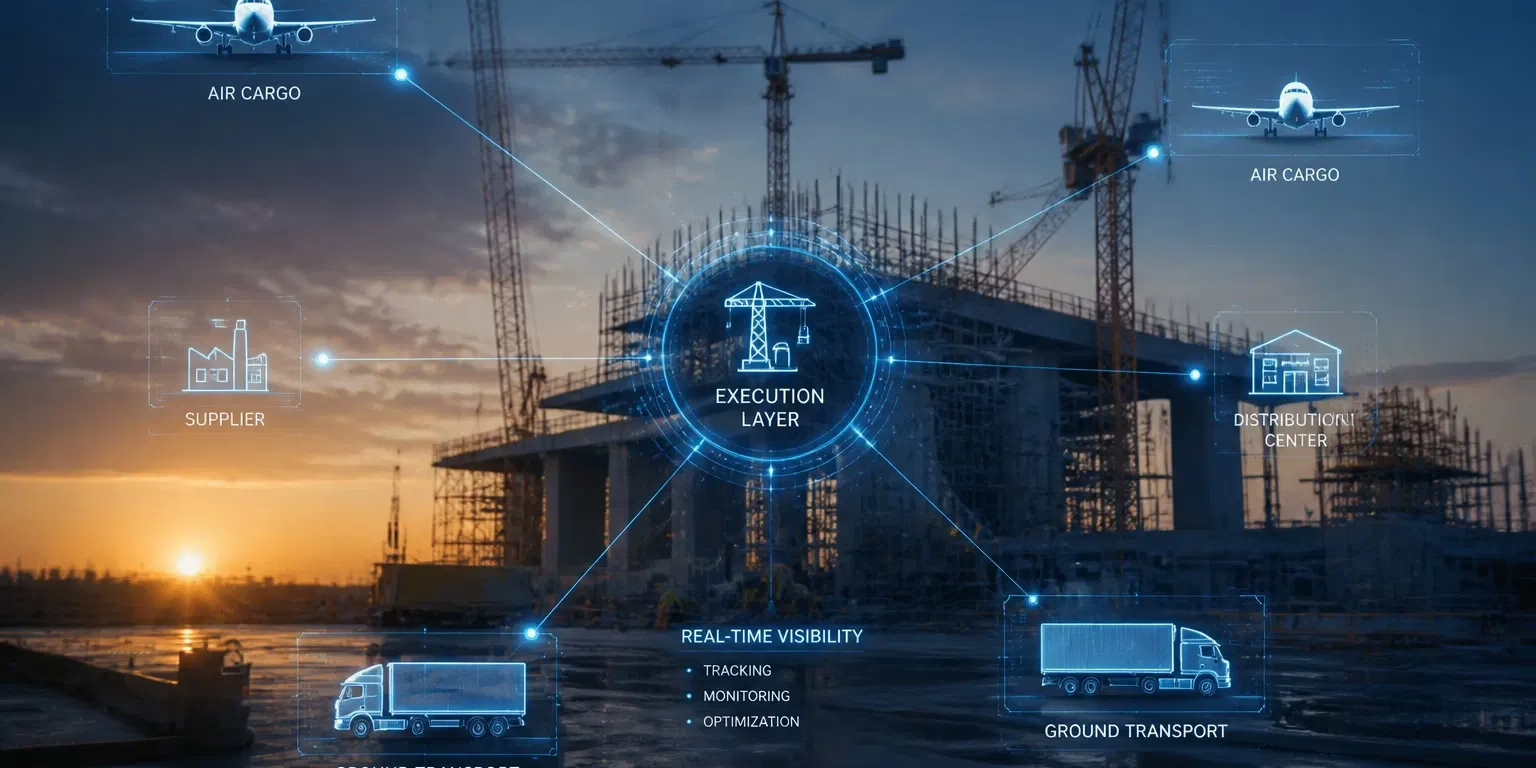
The air cargo industry has spent the last decade obsessed with visibility. We have invested billions in tracking devices, IoT sensors, and high-fidelity dashboards. The goal was simple: know where the shipment is at all times.
But here is the uncomfortable truth: Knowing a shipment is delayed doesn't move it.
Visibility is passive. It tells you that a plane is delayed or a truck is idling at a terminal. It does not fix the underlying operational breakdown. In fact, many current visibility tools simply give logistics providers a front-row seat to their own failure. They provide the "what," but they offer no mechanism for the "how."
Seeing a missed cutoff on a screen doesn't bridge the gap between stakeholders responsible for resolving it. The real friction in logistics isn't a lack of data — it's the breakdown between systems, teams, and handoffs. This "white space" between stakeholders is where the most sophisticated logistics plans fall apart.
To achieve true freight agility, we must move beyond the dashboard. We must transition from visibility to orchestration.
The Anatomy of the Execution Gap
Freight breaks at the handoffs. In any given international air shipment, a dozen different entities may touch the cargo or the data associated with it.
Consider a standard flow:
- An airline updates its capacity.
- A General Sales Agent (GSA) confirms a booking.
- A freight forwarder submits the required documentation.
- A trucking provider moves the cargo to the airport.
- Ground handlers receive the goods.
- Customs officials clear the entry.
Each of these stakeholders operates within their own silo, using their own legacy systems: spreadsheets, emails, and proprietary portals. While everyone "touches" the shipment, no one truly "owns" the orchestration of the end-to-end event.
When a trucker misses a cutoff or ground handling changes a status, the information often lags or remains trapped in a single system. By the time the delay surfaces on a visibility dashboard, the opportunity to intervene has already passed. We've digitized the silos, but we haven't digitized the handoffs. This is the Execution Gap: the space between knowing an exception occurred and having the coordinated infrastructure to resolve it in real-time.

Defining Execution as Observable Behavior
At ImEx Cargo, we believe that the next generation of logistics technology shouldn't just aggregate data: it should standardize behavior.
Within the Plug-In Freight Ops™ framework, we define execution as observable operational behaviors tied to specific workflow events.
True Supply Chain Execution Visibility isn’t just a GPS dot on a map. It is the ability to see if a partner followed the prescribed workflow at the exact moment the handoff was required. It is about shifting from "Where is my cargo?" to "Is the workflow being executed according to the standard?"
When you treat logistics as a series of coordinated behaviors rather than just a series of locations, you can begin to ask the questions that actually drive performance.
The Five Questions of High-Performance Execution
To move toward a model of Logistics Orchestration, organizations must be able to answer five critical questions about their live operations:
- Where are handoffs consistently failing? Identify the specific nodes where communication or physical transfer breaks down.
- Which partners create the most delays? Move beyond anecdotal evidence to hard, performance-based accountability.
- How many manual touches exist per shipment? Calculate the "friction cost" of emails, phone calls, and manual data entry.
- Where is exception risk building before service failure occurs? Predict a missed flight or cutoff hours before it happens.
- Which workflows need intervention now? Direct your team’s attention to the 5% of shipments that actually require human problem-solving.
By answering these questions, freight operations become measurable and, more importantly, improvable. You are no longer managing by crisis; you are managing by orchestration.
From Visibility to Accountability
The shift to Multi-Stakeholder Execution requires a new kind of digital infrastructure. It requires a layer that sits above existing systems: TMS, WMS, and ERPs: to coordinate the handoffs between them.
This is why we built Plug-In Freight Ops™. It is not a replacement for your existing tech stack; it is the coordination layer that makes your stack work. It provides the structured handoffs and partner accountability necessary to ensure that when an airline updates capacity, the trucker, the forwarder, and the ground handler are all automatically synced into a single, coordinated response.
This level of cargo workflow automation ensures that accountability is baked into the process. If a milestone is missed, the system doesn't just record it: it triggers the next best action to mitigate the impact.

Just-In-Time Execution Intelligence
The future of the air cargo industry is not just digital visibility; it is Digital Coordination.
In the coming years, fragmented communication: relying on tribal knowledge, messy email chains, and outdated spreadsheets: will become a terminal liability. The organizations that thrive will be those that leverage "just-in-time execution intelligence."
This means having a system that understands the dependencies of a shipment. If Customs creates a delay, the orchestration layer should immediately understand the downstream impact on the trucking schedule and the airline booking, providing the data necessary to adjust the plan instantly.
This is particularly critical for large-scale infrastructure projects and federal logistics programs where DBE networks and workforce pipelines must be activated. Execution isn't just about moving the box; it's about coordinating a massive ecosystem of diverse suppliers and talent to meet complex compliance and operational goals.
The Competitive Advantage of Coordination
For decades, the competitive advantage in logistics was based on who moved the most freight or who had the largest fleet. Today, that has changed.
The next competitive advantage for airlines, GSAs, forwarders, and logistics providers will not be who moves freight: it will be who coordinates freight best.
Moving from visibility to orchestration is more than a technical upgrade; it is a category shift. It is the move from seeing the problem to owning the solution.
At ImEx Cargo, we are helping organizations bridge this gap. Whether you are managing a complex air cargo network or a multi-party infrastructure program, the goal remains the same: total execution certainty.
Stop watching your freight. Start coordinating it.
Are you ready to move beyond the dashboard?
We typically address these challenges through a focused pilot program designed to map your current execution gaps. We can walk through how the Plug-In Freight Ops™ architecture would apply to your specific environment and multi-stakeholder ecosystem.
Contact ImEx Cargo today to schedule a capability walkthrough.