By Michelle DeFronzo
Air cargo has made meaningful progress in digitalization. Shared data models, application programming interfaces, cargo community systems, automation and visibility tools have improved how shipment information moves across the ecosystem.
But information exchange is not the same as coordinated execution.
A shared event may show that cargo has arrived. A dashboard may identify a missed cutoff. A predictive model may flag a shipment as at risk. None of those, by themselves, answers the operational questions that determine whether the shipment recovers:
- Who owns the next action?
- Who accepts responsibility for the handoff?
- How is completion confirmed?
- Who escalates the exception?
- What evidence shows that the issue was resolved?
That gap is the case for air cargo execution infrastructure: a coordination layer that connects existing systems and standards to accountable action across organizational boundaries.
Air Cargo’s Digital Decade
The industry has not failed to modernize. It has built important foundations.
IATA’s ONE Record standard defines a common cargo data model, standardized APIs and security mechanisms for sharing shipment information across organizations. IATA’s 2026 specification identifies ONE Record as the preferred air cargo data-sharing standard.
The value is architectural. A common data model makes it more practical for airlines, forwarders, ground handlers and other participants to exchange structured information without relying on disconnected documents and proprietary message formats.
IATA’s digitalization and data-sharing analysis describes the movement from fragmented manual processes toward shared data and greater alignment among airlines, forwarders, ground handlers and technology providers.
Cargo Connect and EPIC address another challenge: partner identification and connectivity across a complex ecosystem spanning more than 40,000 freight-forwarder branches, 450 airlines and 23 cargo community systems.
These are significant developments. They make the air cargo network more connected and more digitally legible.
They do not, however, create a complete responsibility model for every operational handoff.

The Question Data Exchange Does Not Answer
Data exchange can tell participants what happened. Execution coordination must also establish what happens next.
Consider a typical sequence:
- An airline or GSA confirms capacity.
- A forwarder completes documentation.
- A trucking provider moves the shipment to the airport.
- A ground handler receives and processes the cargo.
- Customs or another government stakeholder clears the shipment.
- The cargo is built, transferred and moved toward departure.
Each step may involve a different organization, system and operating standard.
When the shipment proceeds normally, the fragmentation may remain invisible. When something changes, the gaps become operational:
- A truck arrives before cargo is ready.
- A document is incomplete at the point of acceptance.
- A handling event is recorded but not acknowledged by the next party.
- A missed cutoff affects a booking, but no owner is assigned to recovery.
- A predictive alert identifies risk without triggering a defined intervention.
The central problem is not simply that information is unavailable. It is that responsibility is often distributed without being explicitly coordinated.
Fragmentation Was Addressed at the Data Layer, not the Responsibility Layer
Standards are essential because systems cannot coordinate reliably when they do not share common identifiers, events or data definitions.
DCSA Track & Trace standards provide a useful cross-modal precedent. In container shipping, DCSA defines common events, data models and APIs across carriers, terminals, shippers, freight forwarders and technology providers. Its documentation also describes how incompatible data and manual reconciliation create operational problems.
The lesson is relevant to air cargo: standardized information exchange is foundational.
But a standard event does not automatically assign a human or organizational owner. An API does not, by itself, confirm that a handoff was accepted. A shared record does not necessarily document how an exception was resolved across several companies.
The responsibility layer requires additional structure.
Why Visibility and Predictive Intelligence Do Not Produce Resolution
Visibility is necessary. It is not sufficient.
TIACA’s work on AI and digitalization in air cargo illustrates how cargo community systems can exchange advance shipment information so truckers can coordinate visits to handling facilities and avoid unnecessary waiting.
That is a meaningful operational use of shared data. Existing cargo community systems play an important role in appointment management, facility coordination, status exchange and landside visibility.
They are adjacent components of the stack, not the same thing as a neutral execution coordination layer.
Predictive intelligence creates a similar distinction. Banyan Technology’s “Deliveries at Risk” is vendor-published product evidence showing how the market is moving from tracking toward identifying shipments likely to miss expected delivery timing and supporting proactive intervention.
That example is not independent research, and it is not specific evidence about air cargo. It does demonstrate an important market direction: identifying risk is more valuable when it supports action.
Cathay Cargo’s digitalization work provides another example. Its AI-assisted screening identifies potential trade-control requirements for frontline follow-up.
The broader operational point is clear: digital intelligence still depends on accountable action. A system can identify a potential issue, but people and organizations must still determine who reviews it, what action is required and how completion is recorded.
Why Air Cargo Is a Compelling Environment for a Neutral Execution Layer
Air cargo combines high coordination density with strict timing requirements.
The operating environment includes:
- Airlines and airline operations teams
- GSAs and GSSAs
- Freight forwarders
- Ground handling agents
- Trucking providers
- Airports and cargo facilities
- Customs and government stakeholders
- Technology and cargo community systems
Commercial responsibility is also becoming more distributed. As reported by Air Cargo Week and Cargo Airports & Airline Services, Kales leadership cited an increase in the GSSA share of cargo sales from approximately 24% to 27% over five years.
That figure is attributed to Kales leadership and should not be treated as independently audited data. It does, however, illustrate a structural direction: as airlines outsource more commercial activity, coordinated execution across airline, GSSA, forwarder, handler and trucking relationships becomes increasingly important.
The landside environment adds further complexity. Cargo may move through booking, tender, acceptance, screening, warehouse processing, truck appointment, build-up, flight departure and final delivery, often with different parties responsible for each stage.
A neutral coordination layer is compelling in this environment because no single participant necessarily owns the complete workflow.
Standards Make Coordination Practical
An execution coordination layer should not replace standards. It should use them as foundations.
ONE Record supports a shared air cargo data model, secure APIs and more consistent information exchange. Cargo Connect and EPIC address partner identification and connectivity. DCSA demonstrates how common events and APIs can reduce manual reconciliation in another transportation mode.
The IATA ONE Record industry survey from December 2025 reported that more than 70% of respondents were aware of ONE Record, nearly 50% indicated readiness, and respondents expressed demand for pilots, demonstrations and implementation examples. IATA also identified more than 30 active pilot projects.
Those findings support the need for practical implementation. They do not establish the adoption, compliance or endorsement of any particular execution platform.
The next architectural question is how shared data becomes coordinated behavior.
What an Execution Coordination Layer Does
A useful way to frame the problem is as an industry-level reference model the air cargo ecosystem still needs to define and agree on collectively.
This six-step chain is not a description of any company’s internal process, product workflow, configured operating sequence or technical specification. Different organizations will implement responsibility, confirmation and escalation differently. The value is in the shared vocabulary itself.

Conceptual architecture, not a representation of currently deployed integrations.
Event → Assignment → Handoff → Confirmation → Escalation → Resolution
- Event: A shipment, capacity, documentation, facility or delivery condition changes.
- Assignment: The next responsible party and required action are identified.
- Handoff: Relevant information, timing and conditions are transferred across the organizational boundary.
- Confirmation: The receiving party acknowledges ownership or completion.
- Escalation: A missed response, exception or timing risk is raised through an agreed path.
- Resolution: The corrective action is completed and documented with evidence.
Taken together, these steps describe the general operational question sequence common to multi-organization freight execution: what changed, who owns the next action, who accepts the handoff, whether completion is acknowledged, whether an issue must be raised, and whether the matter is resolved.
This structure changes the operating question from “What is the status?” to “What action is required, who owns it and has it been completed?”
That is the distinction between visibility and multi-stakeholder execution.
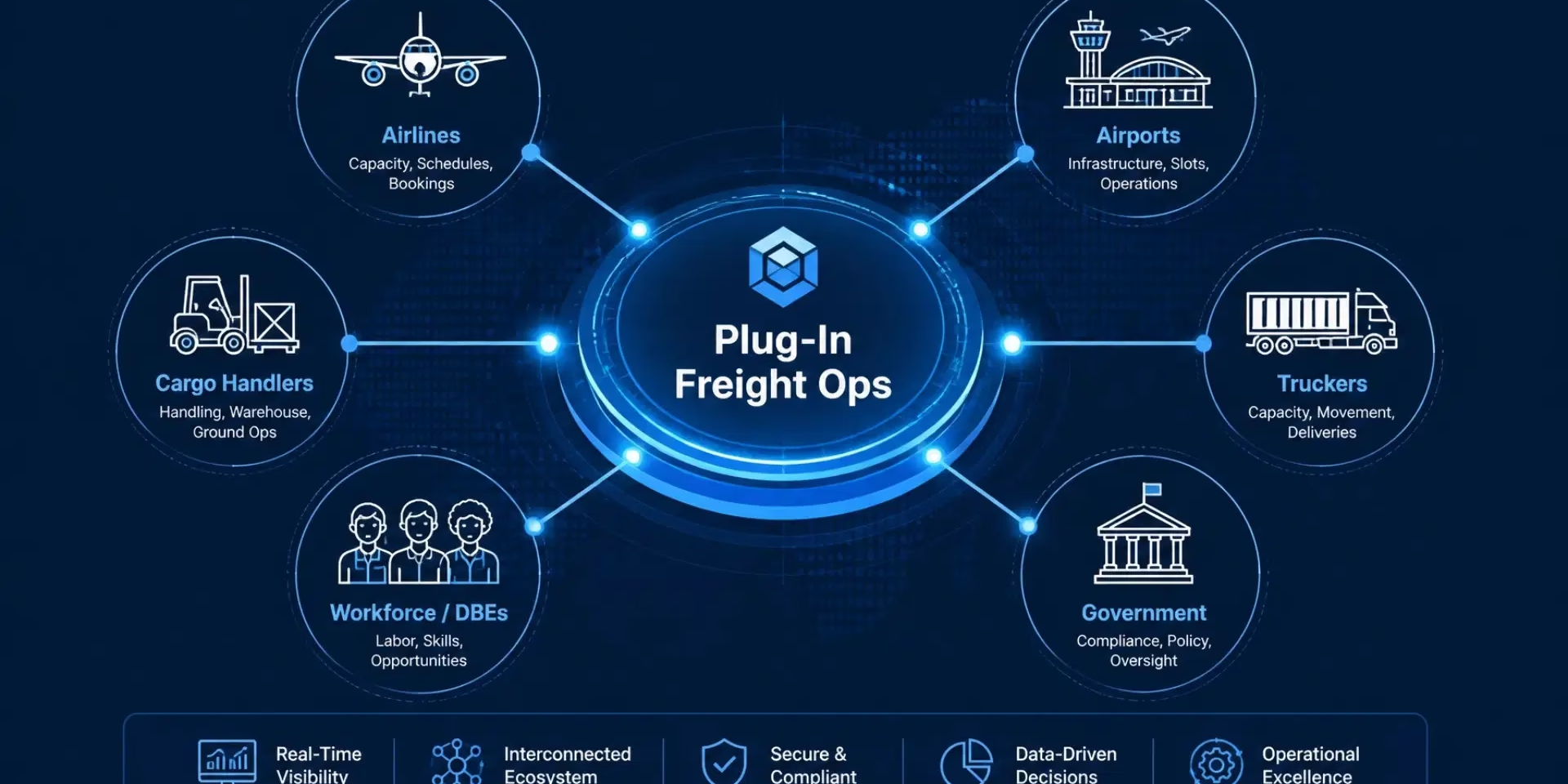
Plug-In Freight Ops™ as an Emerging Architecture
Within this emerging category, Plug-In Freight Ops™ is one proposed architecture designed to coordinate execution above existing systems rather than replace them. Its specific implementation is a separate technical discussion.
This is an architecture thesis, not evidence of product validation, commercial adoption or third-party endorsement.
The Evidence Still Needed
This article deliberately avoids market-size and efficiency-percentage claims drawn from earlier press coverage because those figures are not independently verified. No such figure is used or relied upon here, and that is a sourcing standard for this discussion rather than a correction to the broader argument.
The category will not be established by language alone.
The next meaningful evidence is a documented, repeatable airline–handler–trucker exception workflow that demonstrates:
- The triggering event
- The responsible parties
- The required handoff
- The confirmation mechanism
- The escalation path
- The resolution record
- The measurable operational outcome
That workflow should be reviewed by at least one independent operational or technical stakeholder. The review must be permitted to identify limitations or challenges, not simply confirm the proposed architecture.
This distinction matters. Industry sources can validate that fragmentation, interoperability and exception-management problems exist. Standards can validate that shared data models and APIs are practical architectural foundations. Neither establishes that Plug-In Freight Ops™ has solved those problems in production.
That evidence must be earned through demonstration, review and transparent measurement.
Building the Category Around Execution
Air cargo does not need another layer of passive status reporting. It needs a clearer way to connect information, responsibility and action across the organizations that move freight.
The industry’s digital foundations are becoming stronger. ONE Record, Cargo Connect, cargo community systems, APIs, predictive intelligence and automation all contribute to a more connected operating environment.
The unresolved question is what happens between the event and the outcome.
Air cargo execution infrastructure addresses that space. It treats the freight handoff as an accountable workflow, not merely a data exchange. It recognizes that coordinated resolution requires more than visibility, and that interoperability is necessary but not sufficient.
Plug-In Freight Ops™ is one emerging architecture within that discussion. The broader category belongs to the industry: airlines, GSAs and GSSAs, forwarders, handlers, truckers, airports, standards bodies, technology providers and government stakeholders that are working to make execution more reliable across organizational boundaries.
Readers can explore ImEx Cargo’s digital freight infrastructure resources and the company’s broader perspective on cargo infrastructure and physical operations as this conversation develops.
About the Author
Michelle DeFronzo is the Founder and CEO of ImEx Cargo, a woman-owned logistics and freight-technology company. She builds modular infrastructure that modernizes access and collaboration in operational industries without replacing existing systems.
Her work spans air cargo, freight forwarding, trucking coordination, airline GSA/GSSA operations, government contracting, supply-chain execution and logistics technology. She focuses on platform strategy, ecosystem design and interoperability across fragmented operational environments.
Frequently Asked Questions
What is air cargo execution infrastructure?
Air cargo execution infrastructure is a coordination layer that connects existing systems, standards and operational stakeholders to structured actions across the shipment lifecycle. It focuses on ownership, handoffs, confirmations, escalations and resolution, not visibility alone.
How is execution infrastructure different from a cargo community system?
Cargo community systems facilitate data exchange and coordination among participants in a cargo ecosystem. An execution coordination layer may complement those systems by assigning responsibility for next actions, tracking handoff confirmation and documenting exception resolution across organizational boundaries.
Is ONE Record an execution coordination platform?
No. ONE Record is an air cargo data-sharing standard that provides a common data model, APIs and security mechanisms for sharing shipment information. It is an interoperability foundation. Additional capabilities are required to coordinate accountable multi-party execution.
Why is visibility not enough in air cargo?
Visibility can show where a shipment is or identify that a milestone is at risk. It does not necessarily assign the next action, confirm who owns the response or document how an exception was resolved across multiple organizations.
Has Plug-In Freight Ops™ been independently validated?
This article does not claim independent product or commercial validation for Plug-In Freight Ops™. Independent validation is a future evidence goal involving a documented operational or technical review of a repeatable airline–handler–trucker exception workflow.