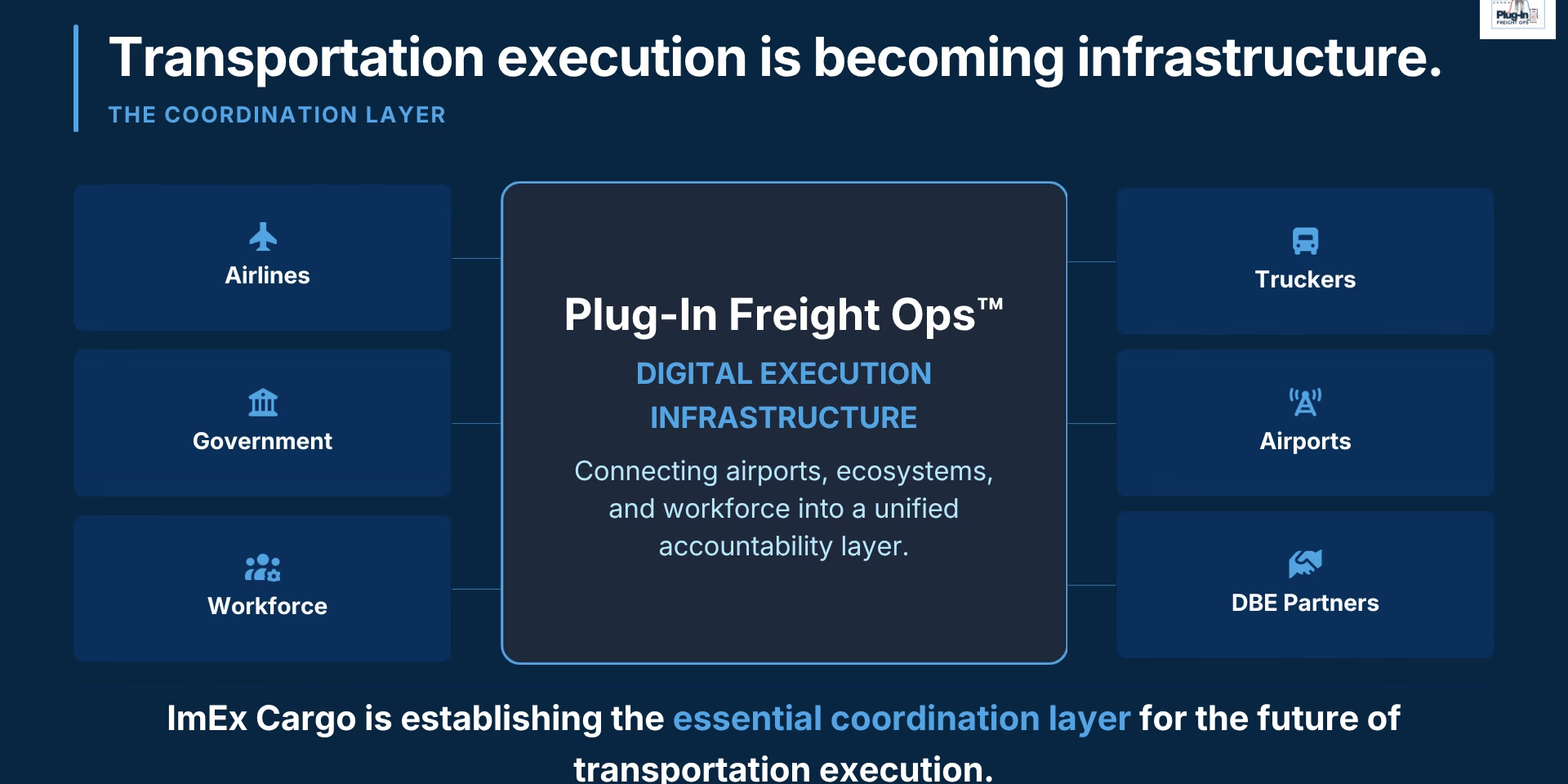
In the current logistics landscape, fragmentation is the default. Every stakeholder: from the airline and the trucking provider to the government agency and the small DBE subcontractor: operates on a different system.
For years, the industry’s response to this fragmentation has been connectivity. The goal was simple: make System A talk to System B. This gave rise to the dominance of API integration platforms. These tools act as the "digital pipes" of the supply chain, moving data packets from one server to another.
But here is the reality we’ve seen at ImEx Cargo: connectivity does not equal coordination.
Just because your TMS can "talk" to a carrier’s tracking system doesn't mean the shipment is moving efficiently, that the handoff was verified, or that the partner is being held accountable for their SLA. One is a technical achievement; the other is an operational outcome.
This article defines the distinction between API Integration Platforms (the pipes) and Plug-In Freight Ops™ (the conductor), and why your digital freight infrastructure requires both to function at scale.
The API Integration Platform: Building the Pipes
An API (Application Programming Interface) integration platform is designed to solve a technical problem: system-to-system interoperability.
Think of platforms like MuleSoft, Dell Boomi, or even logistics-specific integrators. Their primary function is to transport and transform data. They answer the question: "Can my ERP send an order to my 3PL's warehouse management system?"
These platforms are essential. Without them, we are stuck with manual data entry and legacy EDI delays. They provide:
- Standardization: Mapping different data formats so systems can understand each other.
- Speed: Moving data in real-time or near-real-time.
- Scale: Managing hundreds of connections without building custom code for each one.
However, an API platform is fundamentally "logistics-agnostic." It doesn't care if it's moving a tracking update for a pallet of electronics or a payroll record for a retail employee. It moves the packet, confirms delivery of the data, and moves on.
Plug-In Freight Ops™: Orchestrating the Action
While API platforms focus on the movement of data, Plug-In Freight Ops™ focuses on the execution of the work.
As a logistics orchestration layer, Plug-In Freight Ops™ sits above your existing systems. It uses the data provided by APIs, but it adds a layer of operational logic, workflow standardization, and multi-party accountability.

It answers the operational questions that APIs cannot:
- "The data says the truck arrived, but did the driver complete the security checklist?"
- "Which partner owns the next step in this multi-leg shipment, and have they been alerted?"
- "Is our diverse supplier (DBE) network being activated according to the project’s compliance requirements?"
Plug-In Freight Ops™ isn't just a freight execution platform; it is a cargo execution infrastructure that governs how work happens across independent organizations.
Comparison: Connectivity vs. Coordination
To understand where these two categories sit in your stack, consider how they handle the core components of a shipment lifecycle.
| Feature | API Integration Platforms | Plug-In Freight Ops™ |
|---|---|---|
| Primary Function | System-to-system connectivity | Multi-party execution coordination |
| Focus | Data transport and transformation | Data + workflows, assignments, and accountability |
| Orchestration | Technical (API routing) | Operational (stakeholder coordination) |
| Workflows | Data pipelines | Structured handoffs across independent orgs |
| Governance | Technical standards (auth, rate limits) | Operational rules (SLAs, performance tracking) |
| Stakeholder Visibility | Technical teams / IT | All ecosystem participants (Airlines, Truckers, DBEs) |
| End Goal | Interoperability | Verified Execution |
Why Connectivity Isn't Enough for Complex Logistics
If you are managing a simple point-to-point shipment, a data connection might be enough. But modern logistics: especially in government infrastructure, high-stakes air cargo, and multi-modal project cargo: is rarely simple.
Execution breaks down at the handoffs. When a shipment moves from an airline to a ground handler, then to a specialized trucking provider, then to an on-site installation team, a "data pipeline" is insufficient.
The Governance Gap
An API integration platform can tell you that a status changed to "Delivered." It cannot tell you if that delivery met the governed logistics orchestration standards required for a federal contract. Plug-In Freight Ops™ embeds these rules into the workflow itself, ensuring that every participant: from prime contractors to small DBEs: is executing within the same framework of accountability.

The Stakeholder Gap
API platforms are generally "hidden" from the people doing the actual work. They live in the background of the IT department.
In contrast, a cargo execution command center provides a shared interface for everyone involved. Whether it's a dispatcher at a trucking company or a program manager at a government agency, they aren't just looking at data: they are participating in a coordinated execution layer.
Moving Beyond Data Pipelines: The Execution Layer in Action
When we deploy Plug-In Freight Ops™ as a logistics operating system, we aren't replacing the existing APIs or the underlying TMS/ERP. We are activating them.
By layering a supply chain execution layer over the top of fragmented systems, organizations gain:
- Structured Handoffs: Every transition between stakeholders is a governed event with required inputs and verification.
- Real-Time Accountability: We move from "Where is my freight?" to "Who is responsible for the freight right now, and are they on schedule?"
- Neutral Coordination: Because Plug-In Freight Ops™ acts as a neutral coordination infrastructure, it can sit between competing airlines or diverse vendors to ensure the project’s success takes priority over individual system silos.

Complementary Roles: How They Work Together
It is important to note that this is not an "either/or" scenario. In a mature digital freight infrastructure, these tools are highly complementary.
The API integration platform handles the "heavy lifting" of data translation between legacy systems. Plug-In Freight Ops™ then consumes that standardized data to drive multi-stakeholder execution and ecosystem coordination.
One builds the road; the other manages the traffic.

Conclusion: Orchestrating the Future of Freight
If your operations are still struggling with delays, lack of accountability, or "black holes" in your visibility, the answer likely isn't more integrations. You may have already built the pipes, but you lack the conductor.
At ImEx Cargo, we focus on the freight operating system that turns connectivity into supply chain execution visibility. We help organizations move beyond just "talking" to their partners and start executing with them.
Is your execution layer ready for the next project?
We typically address these coordination gaps through a focused pilot program or a capability walkthrough. We can map how Plug-In Freight Ops™ would sit above your current API environment to improve speed, accuracy, and partner accountability.
Contact ImEx Cargo to schedule a discussion about mapping this coordination layer to your current operation.