Let’s be real: the "Rip and Replace" era of logistics technology has reached its expiration date.
Over the last decade, we’ve seen over $10 billion poured into the digital freight market. Every week, a new platform promises to be the "Uber for freight" or the "OS for global trade." Yet, if you talk to any VP of Operations at a major airline, GSA, or infrastructure firm, the primary challenge remains exactly the same: execution still breaks down at the handoffs.
The industry is littered with expensive software that functions perfectly in a vacuum but fails the moment a shipment touches another stakeholder’s system.
The hard truth? Global logistics is a "brownfield" environment. It is built on legacy systems, diverse protocols, and complex physical assets that aren't going anywhere. Modernization isn’t about building a bigger, shinier silo: it’s about creating digital freight infrastructure that makes existing systems play nice.
It’s about interoperability, not disruption.
The "System Replacement" Trap: Why $10B hasn't solved execution
When a tech provider tells you that you need to replace your entire TMS or ERP to get "real-time visibility," they aren't solving your problem; they are creating a new one.
System replacement is locally efficient but network-blind. You might optimize your internal data, but:
- Your carriers still use their own dispatch stacks.
- Your GSAs still operate on legacy airline systems.
- Your subcontractors and DBE partners are often left out of the digital loop entirely.
This creates execution blind spots. The "system replacement" trap assumes that if everyone just used one app, logistics would be solved. But in a multi-stakeholder environment: especially in high-stakes airline charters or large-scale infrastructure projects: forcing a single system on every partner is an operational impossibility.
The result? Fragmentation. We have thousands of "modern" systems that still require phone calls, emails, and PDFs to manage the actual transportation execution.
Interoperability vs. Disruption: The Case for a Neutral Layer

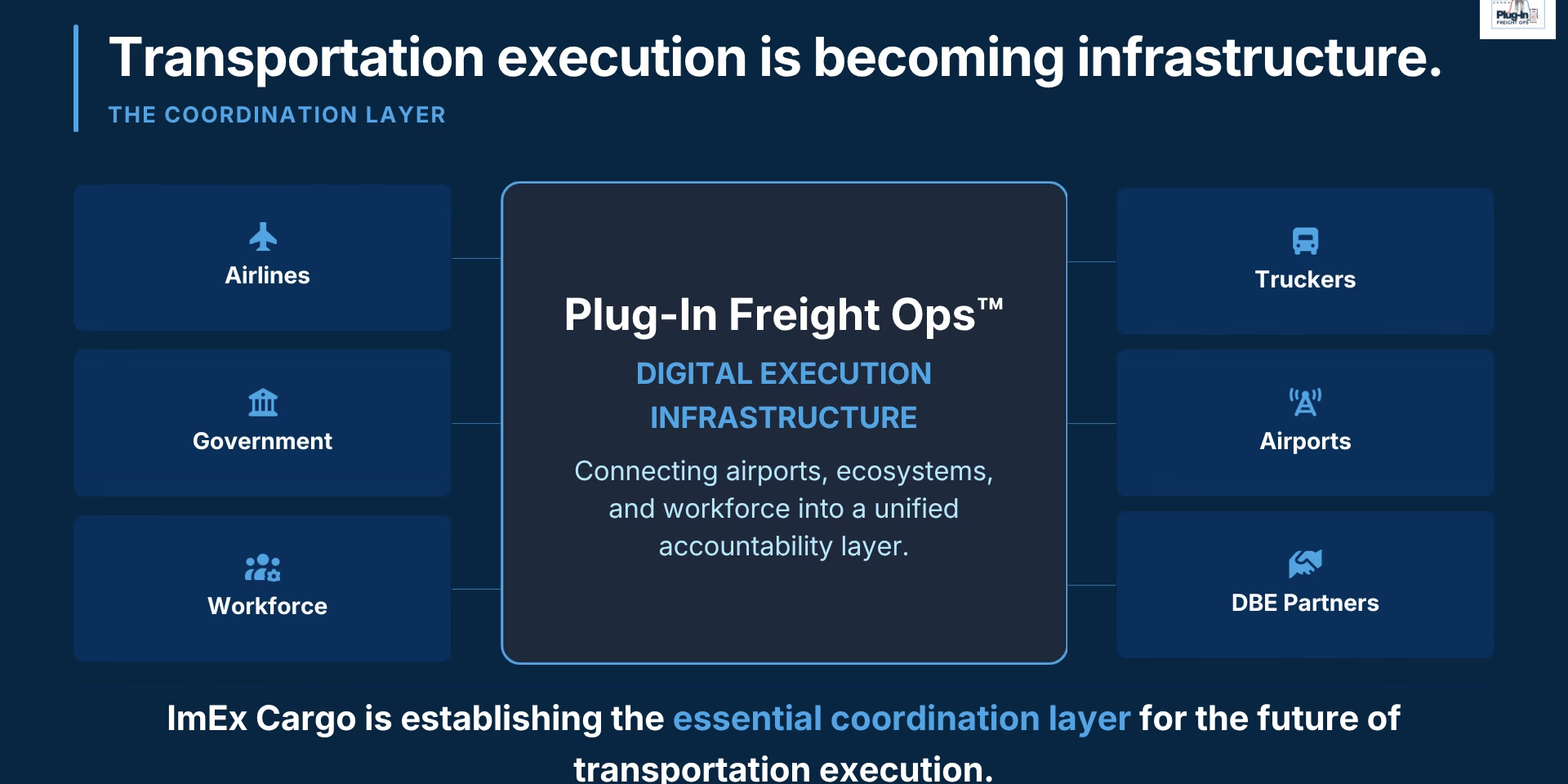
At ImEx Cargo, we realized that the missing piece wasn't another app: it was an execution coordination layer.
This is the philosophy behind Plug-In Freight Ops™. Instead of asking a prime contractor or an airline to rip out their existing infrastructure, we provide a digital execution layer that sits above the fray.
Interoperability allows us to standardize and manage execution across the full shipment lifecycle: from quote to booking to tracking and delivery: without disrupting the tools your team already knows.
Why a Neutral Layer Wins:
- Execution Accountability: It provides a single source of truth that records every handoff. If a delay happens at the warehouse-to-truck transition, the system flags it instantly.
- Workflow Standardization: It forces a structured process (Quote → Book → Track) onto a fragmented group of stakeholders.
- Reduced Risk: You don’t have to bet the farm on a multi-year IT overhaul. You plug in, coordinate, and execute.
Execution Readiness: Scaling Systems, Partners, and Compliance
For infrastructure primes and federal agencies, logistics isn't just about moving a box from A to B. It’s about compliance and economic impact.
Large-scale programs often require the activation of diverse partner ecosystems, including certified DBE (Disadvantaged Business Enterprise) networks. This is where system replacement usually fails the hardest.
Small, diverse suppliers rarely have the capital to integrate with a massive, proprietary enterprise system. By focusing on interoperability, Plug-In Freight Ops™ allows these partners to be activated through a unified system.
We aren’t just tracking a truck; we are tracking the performance and compliance of the entire ecosystem. This level of audit-ready oversight is what transforms a "logistics cost" into a "strategic program asset."
Moving Beyond "Tracking" to Real-Time Execution

"Visibility" has become a buzzword that usually just means "I can see a dot on a map." But a dot on a map doesn't tell you if the paperwork is missing or if the handoff failed.
True transportation execution requires visibility into the action, not just the location.
- Did the carrier accept the booking within the SLA?
- Was the proof of delivery (POD) uploaded within 15 minutes of arrival?
- Is the GSA managing capacity efficiently across the network?
When you prioritize interoperability, you get a "connected decision network." You move from reactive firefighting to proactive coordination. You stop asking "Where is my freight?" and start asking "How do we optimize the next handoff?"
Why Interoperability is the Prerequisite for AI
Everyone wants to talk about AI in logistics. But AI is only as good as the data it consumes.
If your data is trapped in five different silos: some in an old AS/400 system, some in a modern SaaS TMS, and some in a spreadsheet: your AI is starving.
By implementing an execution infrastructure layer like Plug-In Freight Ops™, you create the clean, standardized data stream that AI needs to actually be useful. Whether it’s predictive ETA modeling or automated routing, it all starts with systems that can talk to each other in real-time.
The Operational Reality

Modernizing global logistics is not a tech problem; it is a coordination problem.
The companies that will win the next decade are not those with the most expensive software, but those with the most responsive networks. They are the ones who can bridge the gap between their internal systems and their external partners without friction.
We see this every day at ImEx Cargo. Whether we are coordinating airline cargo networks or managing complex infrastructure programs, the goal is always the same: Structure the handoff. Ensure accountability. Execute.
Where do you go from here?
If your current operations are breaking down at the handoffs: or if your "modern" tech stack still requires 50 emails a day to track a single shipment: it’s time to stop looking at system replacement and start looking at execution infrastructure.
We typically address these challenges through a focused pilot. We don't ask you to change your stack; we just show you how to coordinate it.
Ready to move from "visibility" to "execution"?
Request a pilot to see how this applies in your environment. Let’s map your current operation and see where the coordination layer can bridge the gaps.
About the Author:
Michelle DeFronzo is the CEO of ImEx Cargo and the architect behind Plug-In Freight Ops™. With decades of experience in air cargo, GSAs, and complex logistics execution, she focuses on building digital infrastructure that solves the "handoff problem" for global logistics leaders.