I’ve spent my entire career in the middle of the air cargo machine. If there’s one thing I’ve learned, it’s this: The industry doesn’t have an information problem. It has an execution problem.
We are swimming in data. We have APIs, tracking numbers, status updates, and "visibility platforms" coming out of our ears. And yet, shipments still sit on tarmacs. Documentation still goes missing at the handoff between the trucker and the ground handler. Communications still break down when a flight is delayed and the GSA, the forwarder, and the terminal aren't looking at the same playbook.
I’m convinced that the "gap" between seeing what is happening and actually making it happen is where the real cost of logistics lies.
The Information Illusion
We’ve normalized a world where a "green checkmark" on a screen in Chicago doesn't necessarily mean a pallet is actually on a plane in Frankfurt.
For years, we’ve been sold the idea that "visibility" is the cure-all. But visibility is passive. Knowing your house is on fire is useful; having a fire truck at the door is execution.
In air cargo, we have plenty of smoke detectors, but not enough fire trucks.
I call this the Information Illusion. We mistake a digital update for physical movement. But air cargo doesn't move through software; it moves through people, equipment, and highly specific physical handoffs. When those stakeholders are disconnected: using different systems, following different rules, and operating in silos: that information doesn't lead to execution. It leads to noise.

The Real Product is the Handoff
When you strip everything away, the "product" we provide in logistics isn't a plane or a truck. It’s the handoff.
Execution lives in the white space between the airline, the GSA, the trucking provider, and the government agency. This is where fragmentation lives. This is where delays are born.
I've seen it a thousand times:
- The quote was right.
- The booking was confirmed.
- The track-and-trace says "In Transit."
- But the execution fails because the handler didn't receive the revised load plan, or the DBE subcontractor wasn't alerted to a change in the delivery window.
Software alone can't fix a broken handoff. You need a layer that sits above the software: a way to coordinate the actual execution of the work across every stakeholder involved.
Enter Digital Execution Infrastructure
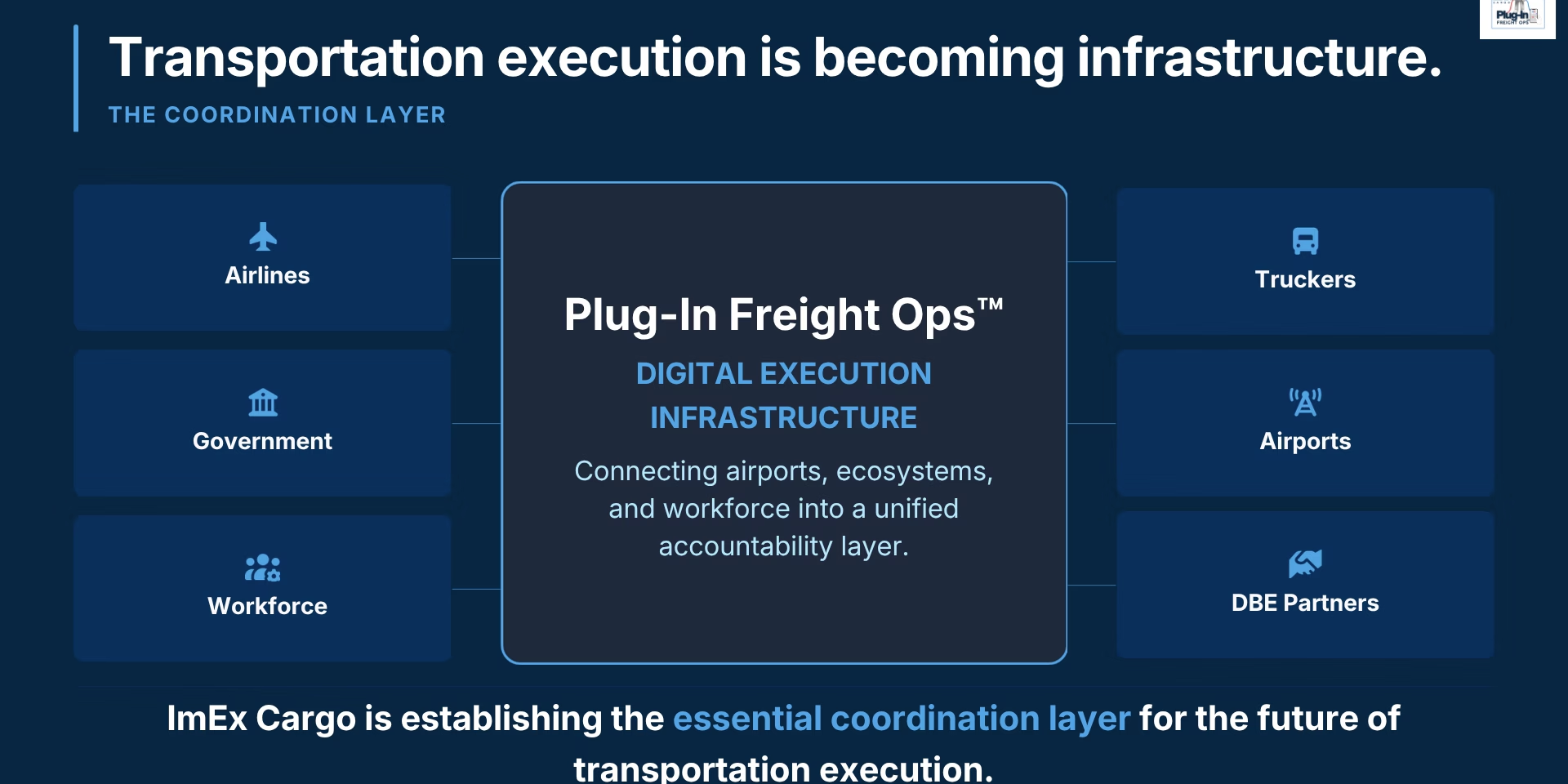
We need to stop thinking about "logistics software" and start thinking about Digital Execution Infrastructure.
Traditional SaaS platforms are designed to help one company manage their work. But air cargo is a team sport. It requires Logistics Orchestration.
Plug-In Freight Ops™ wasn't built to replace the systems people already use. It was built to be the "digital execution layer" that connects them. It’s the infrastructure that ensures a quote moves into a booking, which moves into a trackable event, which results in a verifiable, audit-ready delivery.

This isn't just about a better UI. It’s about Execution Certainty.
When we talk about Execution Certainty, we’re talking about the shift from hoping a partner follows through to knowing the execution is being managed in real-time. It’s about:
- Standardizing the Workflow: Making "Quote → Book → Track" a single, unbroken chain.
- Activating the Ecosystem: Bringing DBE partners and workforce pipelines into the same execution loop as the prime contractors.
- Neutral Coordination: Providing a single source of truth that an airline, a forwarder, and an airport authority can all rely on without changing their internal tech stack.
Why Speed Alone Won’t Fix This
The industry is obsessed with "faster." Faster planes, faster quotes, faster data.
But speed without coordination is just a faster way to reach a bottleneck. If you fly a shipment across the ocean in 8 hours only for it to sit in a warehouse for 48 hours because of a fragmented handoff, the "speed" of the aircraft was irrelevant.
We don't need faster silos. We need a more connected foundation.
I believe the future of our industry belongs to those who control the orchestration, not just those who own the assets. Whether you are an Airline GSA managing capacity or a Freight Forwarder managing complex project cargo, your value is no longer in "moving boxes." Your value is in providing execution certainty in an uncertain world.

Closing the Gap
We’ve reached the limit of what "visibility" can do for us. It’s time to move toward Execution Infrastructure.
At ImEx Cargo, we’re seeing this transition happen in real-time. Organizations are realizing that the space between information and execution is a cost center they can no longer afford to ignore. They are looking for a way to "plug in" to a coordinated network that actually moves the needle.
We typically address this through a focused pilot or a capability walkthrough to map our infrastructure to your current operations. If you're tired of the "Information Illusion" and ready for actual execution orchestration, let’s have a conversation.
My question for you: Where is the most common place execution breaks down in your current workflow; and is it a lack of information, or a failure of the handoff?