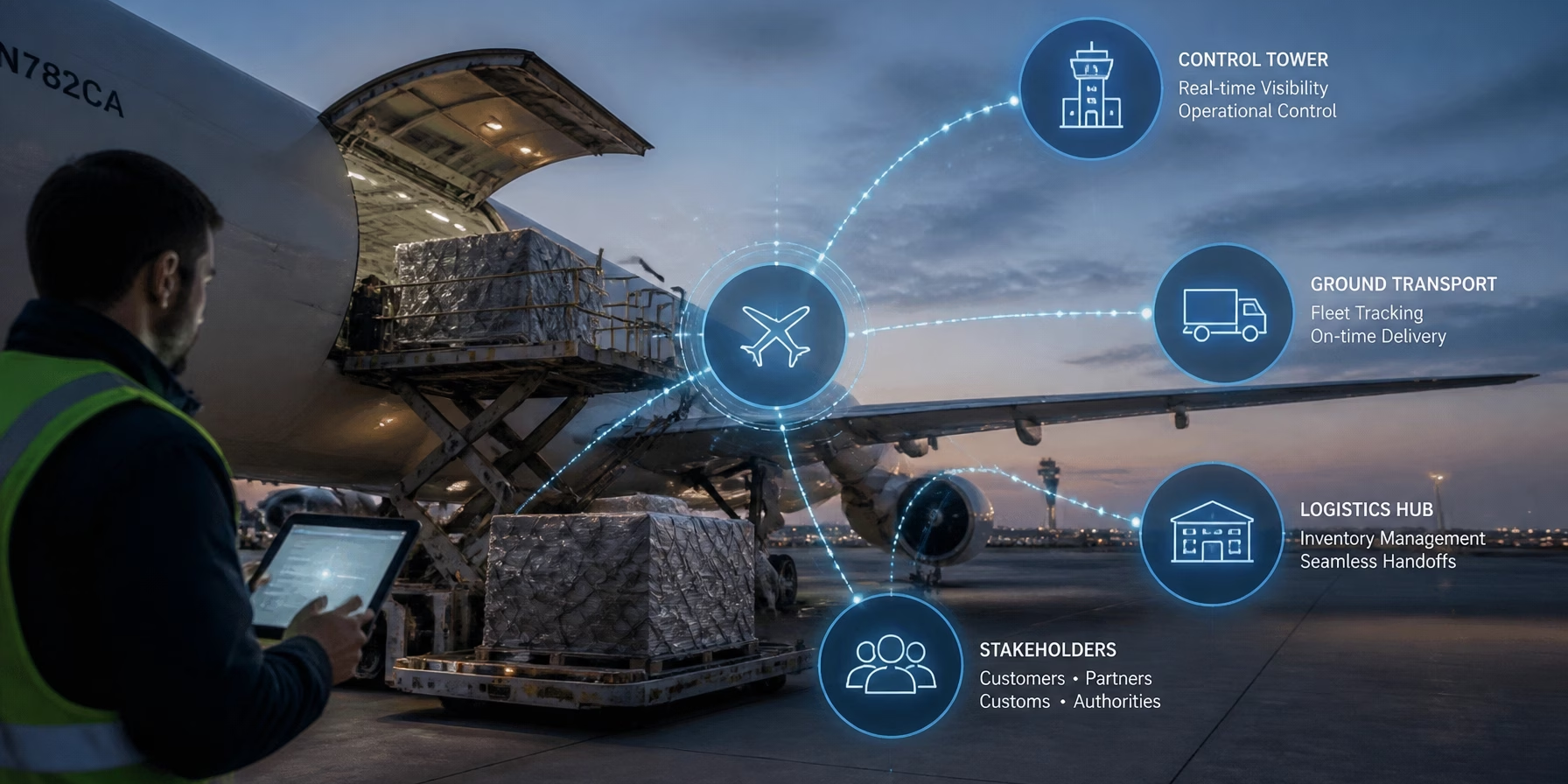
As the United States deploys historic levels of funding through the Infrastructure Investment and Jobs Act (IIJA), most attention still goes to "hard" infrastructure: bridges, ports, and highways. But where execution breaks down is somewhere less visible: the Digital Freight Infrastructure required to coordinate the freight moving across these projects.
For government agencies and prime contractors, the challenge isn't just moving materials. It's moving them with real-time visibility, audit readiness, and measurable participation from Disadvantaged Business Enterprises (DBEs) and Woman-Owned Small Businesses (WOSBs).
Right now, freight execution is still one of the least digitized parts of public project delivery. Project teams may track construction progress in one system, while the actual movement of cargo disappears into a black box of emails, spreadsheets, phone calls, and disconnected carrier portals.
That is why Digital Freight Infrastructure matters. This is not another tech buzzword. It is the missing execution layer between planning and delivery: the layer that standardizes workflows, coordinates stakeholders, and creates transaction-level accountability across freight operations and supplier diversity commitments.
At ImEx Cargo, we are positioning Digital Freight Infrastructure the way the market should have defined it from the start: not as software for software's sake, but as the operational control layer where logistics execution meets real accountability for WOSB and DBE goals.
The Visibility Crisis in Public Projects
Across federal, state, and municipal logistics, execution breakdown usually happens at the handoffs. One party quotes. Another books. Another trucks. Another clears. Another delivers. Accountability gets diluted between each step.
When a prime contractor manages dozens of subcontractors, each with separate trucking providers, freight forwarders, airline partners, or GSAs, operational data gets trapped in silos. The result is delay, finger-pointing, and weak documentation when oversight gets real.
This fragmentation creates three primary risks for public sector programs:
- The Information Gap: Real-time visibility into shipment milestones is rare. Agencies often rely on stale updates from manual communication, which delays decisions and ripples across project schedules.
- Audit Vulnerability: Without a centralized digital history of each shipment, proving compliance, spend accuracy, and partner performance becomes a manual scramble.
- WOSB/DBE Accountability Gaps: A contract may require DBE or WOSB participation, but too often there is no system tracking actual utilization at the shipment level. That makes it harder to verify execution, document good-faith efforts, and prove that diverse partners were meaningfully activated.
This is exactly why Digital Freight Infrastructure is emerging as a blue-ocean category. Search interest is rising, competition is still low, and the market has not clearly defined the term. ImEx Cargo intends to define it through execution: as the connective layer that turns fragmented freight activity into accountable, visible, audit-ready operations.

Plug-In Freight Ops™: The Digital Execution Layer
Developed by operators who have managed cargo desks for over 30 years, Plug-In Freight Ops™ was built to solve the specific coordination failures of complex logistics environments.
Rather than competing with existing Transport Management Systems (TMS) or carrier portals, it sits above them as a Digital Freight Infrastructure layer. It standardizes how information moves across the full shipment lifecycle: from quote to booking to tracking and delivery.
This matters because Digital Freight Infrastructure is only useful if it creates execution discipline. If it cannot coordinate stakeholders, document handoffs, and surface accountability in real time, it is just another tech label.
How it Coordinates Multi-Stakeholder Environments:
- Centralized Workflow: It connects airlines, GSAs, freight forwarders, and trucking providers into one coordinated execution view.
- Structured Handoffs: Every transition, from booking to tender to final delivery, is documented with clear accountability.
- Predictive Milestones: The platform moves beyond reactive tracking, giving teams visibility into potential delays before they disrupt the project schedule.
- Execution Standardization: It creates a repeatable operating model across fragmented partners without forcing a rip-and-replace of existing systems.
For government agencies, this means portfolio-level visibility. For prime contractors, it means tighter control over a fragmented logistics chain. For the market, it gives a real definition to Digital Freight Infrastructure: the execution layer that makes coordination measurable.
Operationalizing Diversity: Beyond the "Check-the-Box"
One of the most important advantages of Digital Freight Infrastructure is that it turns supplier diversity from a reporting exercise into an execution workflow.
For years, DBE participation has been tracked mainly through high-level contract commitments. That sounds compliant on paper, but it often breaks down in live operations. Plug-In Freight Ops™ shifts the focus to real-time execution tracking where WOSB and DBE participation can be seen, documented, and measured at the shipment level.
As a certified Woman-Owned Small Business (WOSB) and DBE/ACDBE provider, ImEx Cargo built the platform with a dedicated DBE Opportunity Hub. This feature allows prime contractors to:
- Identify and match with certified diverse suppliers based on NAICS codes and capabilities.
- Onboard WOSB and DBE partners into active execution workflows instead of leaving participation at the proposal stage.
- Capture shipment-level participation data that supports compliance-ready reporting and clearer accountability.

By integrating diversity into the workflow, agencies can move from "intent" to "impact." You no longer have to wait for a quarterly report to see whether participation goals are being met. The data is live, documented, and audit-ready.
That is the real value of Digital Freight Infrastructure. It does not just digitize freight. It creates a system of record for whether WOSB and DBE goals are actually being executed in the field.
Audit-Ready Oversight and Accountability
In the public sector, accountability is not optional. Every dollar spent on infrastructure must be traceable.
When freight execution remains manual, the "audit trail" is often a collection of disparate PDF invoices and email chains. Plug-In Freight Ops™ provides a digital paper trail for every shipment, including:
- Time-stamped milestones for every stage of transit.
- Centralized documentation (AWBs, BOLs, and proof of delivery) accessible to all authorized stakeholders.
- "Proof of Good Faith" logs for DBE outreach and utilization.
This level of transparency reduces the risk for prime contractors and provides government agencies with the factual oversight required for large-scale funded programs.
A Practical Path to Modernization: The 90-Day Pilot
The greatest barrier to digital transformation in logistics is often the perceived complexity of implementation. Many agencies and firms fear multi-year IT overhauls that disrupt current operations.
We address this through a focused pilot approach.
A Plug-In Freight Ops™ pilot typically runs for 90 days and is scoped around a specific project, lane, or coordination challenge. This allows organizations to:
- Demonstrate Measurable Improvement: Track the reduction in manual communication and the increase in visibility.
- Validate DBE Integration: See how the platform activates and tracks diverse partners in a live environment.
- Ensure Adoption: Because the platform is designed for operators, not just technologists, it adapts to the way your team already works: completing their workflow instead of complicating it.

The Future of Infrastructure is Digital
As supply chains become more complex, the organizations that win will be the ones that treat coordination as infrastructure, not overhead.
That is why Digital Freight Infrastructure matters now. It gives agencies, primes, and logistics stakeholders a practical way to close the gap between planning and execution without losing control at the handoffs.
And because "Digital Freight Infrastructure" is still a blue-ocean term, this is a rare moment to lead the category before the rest of the market catches up. ImEx Cargo is not borrowing the phrase. We are grounding it in operational reality: quote, book, track, deliver, and document accountability across every stakeholder involved.
We invite you to move beyond the spreadsheet. Let’s discuss how Digital Freight Infrastructure can provide the visibility, accountability, and WOSB/DBE execution outcomes your project requires.
Ready to see how this applies to your current operations?
Connect with Michelle DeFronzo and our team to map out a pilot program tailored to your logistics environment.