The supply chain industry is moving quickly toward AI. Predictive ETAs, autonomous planning, intelligent routing, and agentic decision-making are becoming central to digital transformation strategies.
But much of this effort starts with an assumption that is rarely examined:
The data is already clean, connected, timely, and governed well enough for AI to act on it.
In complex logistics environments, that assumption often fails.
The problem is not that organizations lack data. Airlines, GSAs, freight forwarders, trucking providers, cargo handlers, airports, customs authorities, and government stakeholders generate enormous amounts of operational information every day.
The problem is that the information is distributed across organizations, systems, formats, and workflows: with no shared execution layer coordinating what happens between them.
AI cannot resolve that problem by itself. It can only interpret and act on the environment it is given.
If that environment is fragmented, AI may simply accelerate the fragmentation.
The industry needs execution infrastructure first. Then AI can deliver on its promise.
AI Is Not a Substitute for Coordination
Artificial intelligence is powerful at identifying patterns, generating recommendations, and automating decisions. It can forecast likely delays, suggest alternative capacity, prioritize exceptions, and optimize individual steps in a process.
But AI does not automatically create:
- Shared definitions across organizations
- Clear ownership of a shipment event
- Reliable timestamps at each handoff
- A common workflow from quote to delivery
- Accountability when an exception occurs
- Permission to act across another company’s system
Those are execution requirements.
A model may predict that a shipment is at risk. It cannot, on its own, determine whether the airline, GSA, forwarder, trucker, warehouse, customs broker, or government program manager owns the next action.
That distinction matters. Visibility identifies a condition. Execution infrastructure coordinates the response.
The Data Problem Is Really a Handoff Problem
Supply chain data is often described as being trapped in silos. That is accurate, but incomplete.
The more consequential issue is what happens between the silos.
A shipment may move through a sequence such as:
Quote → Book → Tender → Pick up → Transfer → Handle → Clear → Deliver
Each stage can involve a different organization, system, operational clock, and definition of completion.
The booking system may show one status. The trucking provider may have another. The cargo handler may be waiting for documents that the forwarder believes were already submitted. A government stakeholder may require audit documentation that exists in email but not in the operational record.
When information crosses these boundaries manually, the execution record becomes incomplete.
The result is not simply a lack of visibility. It is a lack of coordinated action.

Why AI Produces Weak Results on Fragmented Data
AI systems require more than data volume. They require context, consistency, timing, and relationships.
In a fragmented freight environment, those conditions are often missing.
Incomplete operational context
An AI model working from a carrier feed may understand a flight status but not the ground movement required to meet a delivery appointment.
A forwarder’s system may contain booking details but lack the latest warehouse acceptance event. A trucking platform may have a pickup delay that has not yet reached the parties responsible for downstream planning.
Each system contains a piece of the operational truth. None contains the complete execution picture.
Inconsistent definitions
Terms such as “confirmed,” “ready,” “tendered,” “departed,” and “delivered” can mean different things to different stakeholders.
Even performance metrics can vary. One organization may measure on-time performance against scheduled departure. Another may measure against customer delivery commitment.
AI cannot reliably compare or reason across metrics that have not been standardized.
Stale information
Manual uploads, batch files, email updates, and periodic spreadsheet exchanges create delays between an event occurring and that event becoming visible.
By the time an AI system receives the information, the recommended action may already be obsolete.
Real-time intelligence requires more than a real-time dashboard. It requires operational events to move through the network with enough speed and structure to support action.
No defined owner
A prediction without an accountable owner is only an observation.
If a model identifies a likely missed connection, someone must be responsible for reviewing the exception, communicating with the relevant partner, approving an alternative, and recording the outcome.
Without defined ownership, AI produces alerts that add to the queue of work rather than reducing it.
AI Amplifies the System Beneath It
The common expectation is that AI will reduce fragmentation by connecting information and making better decisions.
In practice, AI usually amplifies the architecture beneath it.
If the underlying system is coordinated, AI can improve speed, accuracy, and responsiveness.
If the underlying system is fragmented, AI may create new forms of fragmentation:
- More automated alerts routed to disconnected teams
- Faster decisions based on incomplete records
- Local optimization that creates downstream problems
- Conflicting recommendations from different systems
- Increased confidence in metrics that are not comparable
- Automated exception management without shared accountability
This is why adding an AI assistant to every existing system does not necessarily create an intelligent supply chain.
It may create multiple intelligent silos.
That is not orchestration. It is distributed automation without a common execution model.
Visibility Is Necessary: but It Is Not Execution
The industry has spent years improving shipment visibility. That progress is important. Organizations need to know where freight is, what has happened, and what may happen next.
But visibility alone does not ensure that the next action occurs.
A tracking platform may show that freight has arrived at an airport. It may not show whether:
- The ground handler has accepted the freight
- The documentation is complete
- A truck has been assigned
- The next party has acknowledged the handoff
- The delivery appointment is still achievable
- An exception has been escalated to the correct owner
This is the difference between observing a supply chain and operating one.
A useful execution environment must connect the event to the responsible party, the required action, the timing expectation, and the result.
Only then can AI move beyond reporting conditions and begin supporting coordinated intervention.
What Execution Infrastructure Must Establish First
Before AI can reliably coordinate freight execution, the underlying infrastructure must create a shared operating context across participating organizations.
That does not necessarily mean replacing every existing system. In most logistics environments, replacement is expensive, disruptive, and unrealistic.
The more practical requirement is a coordination layer that works across existing systems and standardizes the execution process above them.
That layer should establish:
A common shipment and project record
Each stakeholder should be working from a consistent reference for the shipment, movement, milestone, and exception.
Structured handoffs
A handoff should include more than a message. It should define what is being transferred, who accepts responsibility, when acceptance occurs, and what evidence confirms completion.
Event standardization
The network needs shared definitions for milestones, status changes, delays, exceptions, and completion.
Role-based accountability
Every critical event should have an accountable owner, an expected response, and an escalation path.
Cross-organization visibility
The relevant parties should see the same operational facts without requiring every stakeholder to use the same underlying software.
Audit-ready history
Actions, approvals, communications, and status changes should be recorded as part of the execution history: not scattered across inboxes and spreadsheets.

The Correct Sequence: Coordinate, Then Predict
The path to useful AI in logistics is not complicated, but it requires discipline.
First, map the execution flow.
Identify every system, organization, handoff, approval, and exception from quote through delivery.
Second, establish shared operational definitions.
Agree on what each milestone means, who owns it, and what data confirms it.
Third, connect the workflow.
Create structured movement of events between participants, even when the underlying systems remain different.
Fourth, measure execution performance.
Track handoff completion, response times, exception aging, missed milestones, and partner accountability.
Then apply AI.
Once the execution layer is connected, AI can support higher-value functions such as:
- Predicting delays before milestone failure
- Identifying recurring handoff risks
- Recommending capacity or routing alternatives
- Prioritizing exceptions by operational impact
- Detecting patterns across carriers, stations, lanes, and partners
- Supporting resource and workforce planning
- Improving performance reviews with shared evidence
The difference is foundational. AI is no longer trying to reconstruct the supply chain from disconnected fragments. It is operating on a structured execution environment.
A New Enterprise Architecture for Multi-Stakeholder Logistics
The next generation of freight technology will not be defined solely by better individual applications.
It will be defined by how effectively those applications, organizations, and workflows operate together.
Recent industry thinking around agentic supply chains makes a similar point: AI agents need access to enterprise context, a semantic layer, an orchestration layer, and human governance before they can act reliably. Capgemini’s research on next-generation supply chains describes this shift as a move from sequential functional decisions toward coordinated, continuously adaptive execution.
The same principle applies across air cargo, multimodal transportation, infrastructure programs, and government logistics.
The architecture must account for the network: not just the enterprise.
That means coordinating organizations that may have different systems, commercial priorities, compliance obligations, and operational capabilities.
It also means recognizing that data governance is not only an IT responsibility. In a multi-stakeholder environment, governance must extend into the operating model: who owns the event, who can change the record, who approves the action, and who is accountable for the outcome.
As IBM explains in its overview of data silos, isolated systems limit real-time analytics, degrade data quality, and make it difficult for teams to work from a shared source of truth.
For logistics, that shared truth must be connected to execution.
Execution Infrastructure Comes Before AI
AI will play a major role in the future of freight. But the industry should not confuse intelligence with coordination.
AI can predict a delay. It cannot compensate for an unowned handoff.
AI can recommend a new route. It cannot ensure that the airline, trucker, warehouse, and consignee all receive and act on the change.
AI can identify a pattern. It cannot create a common operating model where none exists.
Those capabilities require infrastructure that connects systems, stakeholders, events, and accountability across the shipment lifecycle.
This is the role of digital execution infrastructure: a coordination layer that sits above existing systems, standardizes workflows from quote to booking to tracking and delivery, and gives every participant the context required to execute.
The industry does not need to choose between its current systems and a more intelligent future. It needs the layer that allows those systems to work together.
For the full reference library of definitions, comparisons and workflows across digital freight execution, see the PIFO Knowledge Hub.
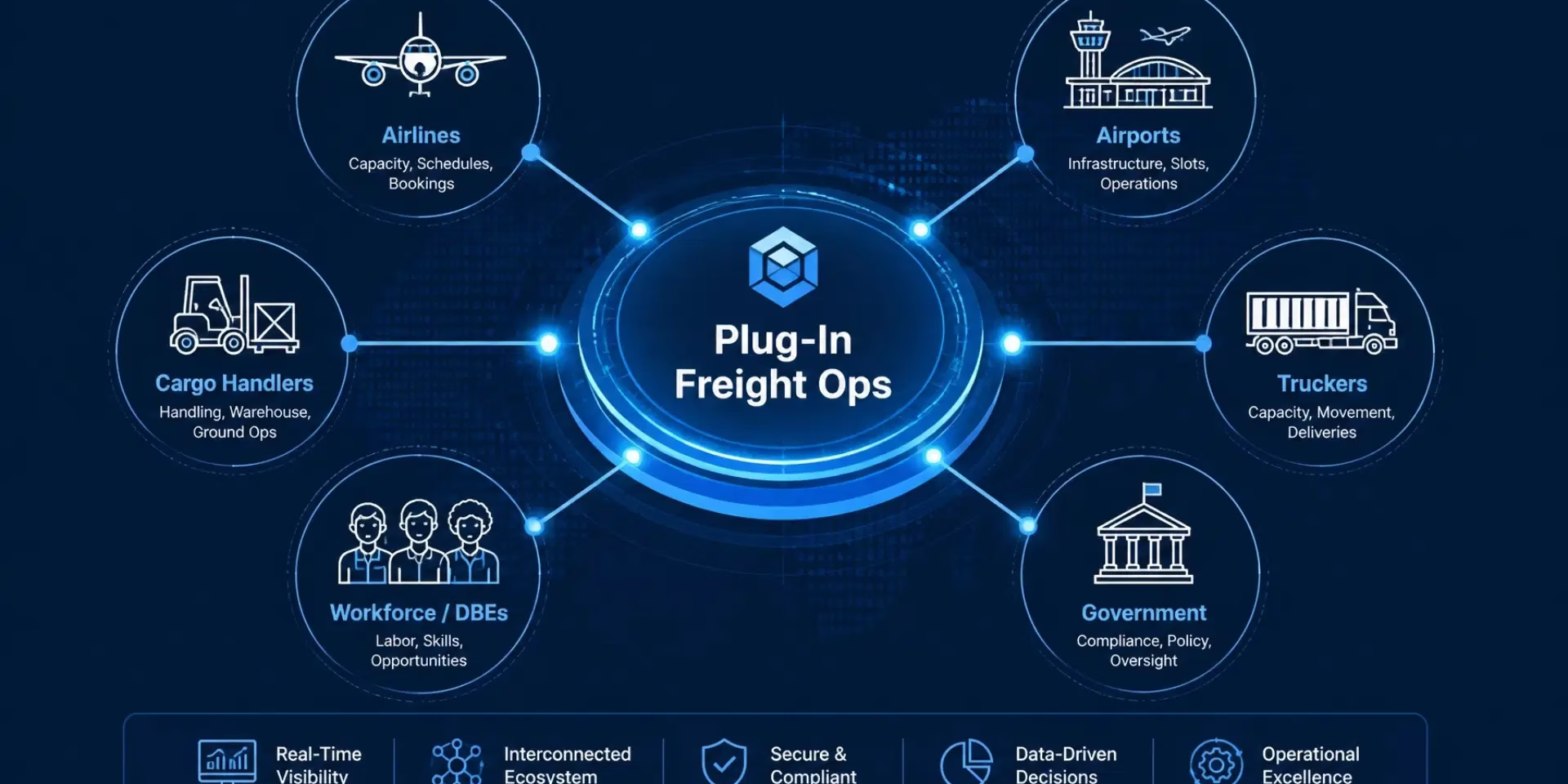
At ImEx Cargo, that approach is embodied in Plug-In Freight Ops™, a digital execution infrastructure layer designed to coordinate airlines, GSAs, freight forwarders, trucking providers, government stakeholders, and ecosystem partners without requiring a rip-and-replace transformation.
The conclusion is straightforward:
First connect the execution. Then apply the intelligence.
That is how AI moves from accelerating fragmented activity to improving coordinated performance.
About the author: Michelle DeFronzo is the Founder and CEO of ImEx Cargo, a woman-owned logistics and freight-technology company with more than 30 years of experience across air cargo, multimodal transportation, government logistics, and complex stakeholder coordination. Her work focuses on building modular infrastructure that modernizes legacy industries through interoperability, execution visibility, and designed collaboration.