If you work in logistics, your day probably doesn't start with a peaceful cup of coffee and a review of your "to-do" list. It starts with an email: or ten: about a missed pickup in Chicago, a customs hold in London, or a truck that’s stuck three states away from where it’s supposed to be.
Most logistics professionals spend 80% of their time "firefighting." We’ve normalized the chaos, treating every shipment as a potential emergency that requires manual intervention, endless phone calls, and desperate spreadsheet updates.
But here’s the reality: firefighting isn’t execution. It’s a symptom of a fragmented system where accountability is optional and visibility is passive.
In this guide, we’re going to look at the "101" of exception management. We'll explore why standard tracking isn't enough, why "visibility" is often a hollow promise, and how to move from reactive panic to structured transportation execution.
The Firefighting Trap: Why Logistics Feels Like an Emergency
In a perfect world, every shipment would follow its planned milestone path. The quote is accepted, the booking is confirmed, the truck arrives on time, and the cargo flies as scheduled.
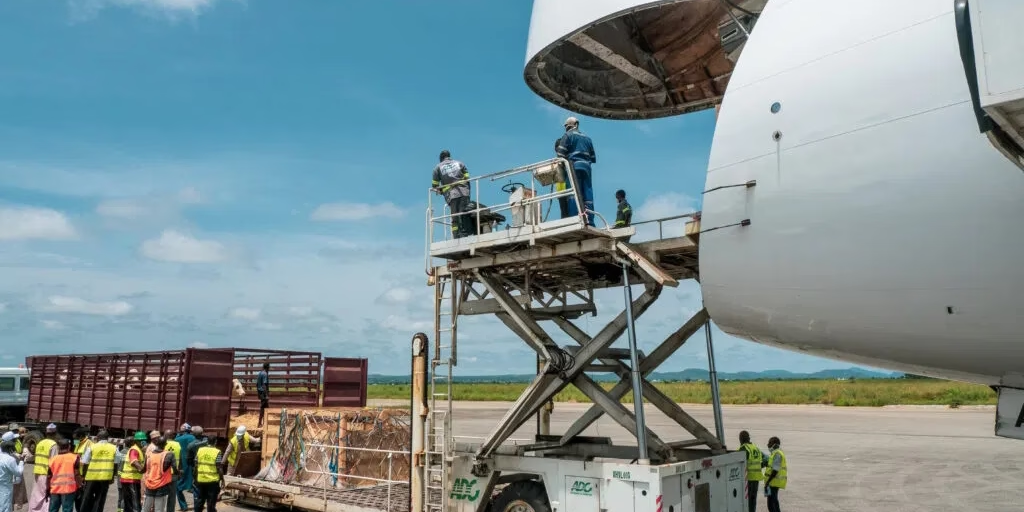
But we don't live in that world. Logistics is a multi-party sport played in a high-friction environment. When you have airlines, GSAs, freight forwarders, trucking providers, and government stakeholders all touching a single shipment, the handoffs are where the fire starts.
Where execution breaks down:
- The Black Hole Handoff: A forwarder drops off at the warehouse, but the status isn't updated in the carrier's system for four hours.
- The "Not My Problem" Loop: A delay occurs, but because ownership isn't defined, the carrier blames the handler, the handler blames the forwarder, and you’re left holding the bag.
- Information Lag: By the time you realize a shipment missed its "Ready for Carriage" (RCS) cut-off, it’s already been sitting for six hours.
This is the firefighting trap. You aren't managing freight; you’re managing the gaps between people and systems.

Why "Visibility" Doesn't Fix the Problem
For the last decade, the logistics industry has been obsessed with "visibility." Every software vendor promises a map with little dots moving across it.
But visibility alone is just a high-definition view of your own problems.
Seeing that a truck is 200 miles off-course is visibility. Knowing why it's off-course, which stakeholder is responsible for fixing it, and having a documented workflow to reroute it is exception management.
Visibility answers the question: "What is happening?"
Exception management answers the question: "What are we doing about it, and who is accountable?"
Most "track and trace" tools are descriptive. They tell you that you're late. To stop firefighting, you need cargo execution management: a prescriptive system that identifies a variance from the plan the second it happens and triggers a coordinated response.
Exception Management 101: Accountability + Coordination
To move from firefighting to executing, you need a framework that prioritizes accountability. In a multi-party environment, accountability cannot be verbal; it must be structural.
1. Define the "Plan of Record"
You can't have an exception if you don't have a baseline. Every shipment needs a digital "contract" of milestones. If a pickup is scheduled for 10:00 AM, that is the milestone. At 10:01 AM, if no "Arrived" status is triggered, you have an exception.
2. Automated Detection
You shouldn't have to look for problems. A robust execution layer, like Plug-In Freight Ops™, monitors these milestones 24/7. When a milestone is missed, the system flags it instantly. No more waiting for a "Where is my freight?" email from the customer.
3. Structured Handoffs
Exceptions often happen during the "gray areas" between stakeholders. By using a digital freight infrastructure, you define exactly who owns the shipment at every stage. When the trucker signs for the cargo, the "Execution Accountability" shifts from the warehouse to the carrier. If an issue arises during that window, there is no question about who needs to resolve it.
4. Multi-Party Coordination
A delay at an airport doesn't just affect the airline; it affects the trucker waiting for the pickup and the final consignee. Traditional systems keep this data in silos. Effective exception management coordinates the response across all parties in a single workflow.

Real-Time Resolution with Plug-In Freight Ops™
This is where ImEx Cargo changes the game. We realized that the industry didn't need another TMS or another "map with dots." It needed an execution layer that sits above existing systems to coordinate the chaos.
Plug-In Freight Ops™ is designed specifically for organizations managing complex, multi-stakeholder logistics. It doesn't replace your current tools; it plugs into them to standardize how you handle exceptions.
Execution Visibility and Accountability
Our platform provides a single source of truth for every participant. Whether it's an airline managing capacity or a prime contractor overseeing an infrastructure project, everyone sees the same milestones and the same exceptions. This reduces "finger-pointing" by 90% because the data is audit-ready and transparent.
Activating the Ecosystem
In many projects, especially those with government oversight, you are required to work with certified DBE and diverse suppliers. Coordinating these smaller partners can often lead to more "fires" if they don't have the same tech stack as a global carrier.
Plug-In Freight Ops™ levels the playing field. It provides the digital infrastructure for these partners to check in, update status, and remain accountable, allowing you to meet diversity requirements without sacrificing execution speed.
Performance Tracking
The best way to manage exceptions is to prevent them. By tracking "Resolution Time" and "Partner Performance," our platform helps you identify which lanes or which providers are consistently causing fires. This allows you to move from daily firefighting to long-term operational optimization.

Moving From Reactive to Proactive
If your team is exhausted, if your "urgent" folder is overflowing, and if you feel like you’re constantly apologizing to customers, you don't have a "tracking" problem. You have an execution problem.
Exception management isn't just a technical feature; it’s an operational philosophy. It’s about deciding that "seeing" a problem isn't enough: you have to have the infrastructure to solve it.
We typically address these challenges through a focused pilot.
We don't ask you to rip and replace your current systems. Instead, we identify one high-friction lane or one complex project and "plug in" our coordination layer. Within 60 to 90 days, the difference is measurable: fewer emails, faster resolutions, and a team that is finally executing rather than just firefighting.
Ready to see how this applies to your environment?
Let’s talk about a pilot. We’d be happy to map out your current workflow and show you exactly where the fires are starting: and how to put them out for good.
About ImEx Cargo
ImEx Cargo operates Plug-In Freight Ops™, a digital execution infrastructure layer designed to coordinate logistics across fragmented, multi-stakeholder environments. We connect airlines, GSAs, freight forwarders, and government agencies into a single, accountable workflow to drive logistics excellence.