The cargo industry is currently obsessed with Artificial Intelligence. From predictive ETA modeling to autonomous warehouse sorting, the boardroom promise of AI is everywhere. Executives are being told that a single algorithm can solve the "chaos" of global logistics.
But there is a problem that no one in the boardroom wants to talk about: AI is useless if it is fed by a 200-email chain.
In the operational reality of air cargo, freight forwarding, and government logistics, data doesn't live in clean, structured databases. It lives in fragmented PDF attachments, manual spreadsheets, WhatsApp messages, and "firefighting" phone calls. This is the operational reality that has been normalized for thirty years.
If your organization is trying to layer AI on top of this fragmentation, you aren't building a "smart" supply chain. You are simply automating the chaos.
The Industry Problem Nobody Talks About
For decades, the logistics industry has accepted operational chaos as "normal operations." We’ve normalized a world where a single shipment requires dozens of touchpoints across disconnected stakeholders just to stay on track.
- Airlines have their capacity systems.
- Freight Forwarders have their TMS.
- Truckers have their ELDs.
- Ground Handlers have their internal spreadsheets.
The problem was never the movement of freight. We know how to move boxes. The problem is the coordination between the people moving those boxes.
When you introduce AI into this environment, it immediately hits a wall. AI requires integrated, reliable, and machine-readable data. It needs to "see" the entire lifecycle of a shipment to make a prediction. But when that lifecycle is broken across five different systems and a hundred email threads, the AI is effectively blind.
The "Garbage In, Garbage Out" Trap
In logistics, "dirty data" isn't just a nuisance: it’s a strategy killer. Most AI strategies fail because they are built on a foundation of fragmented data.
Consider the "ground truth" an AI needs to predict a delay. It needs to know exactly when the truck arrived at the warehouse, how long the offloading took, and when the handler scanned the master air waybill (MAWB).
If the truck arrival was scribbled on a paper log and entered into a system three hours later, the AI’s prediction is already wrong. If the status updates are entered in batches at the end of a shift, the "real-time" AI is actually looking at history.
Without a Digital Freight Infrastructure layer to capture these handoffs in real-time, your AI is learning from noise, not patterns.

Built From 30+ Years of Operational Reality
Michelle DeFronzo, the founder of ImEx Cargo, didn't build Plug-In Freight Ops™ in a Silicon Valley boardroom. She built it from the operational pain of thirty years inside the industry: managing airlines, trucking networks, and complex government cargo projects.
She realized that the industry didn't need "more software." Operators were already drowning in software. What the industry lacked was a connective execution layer.
This realization changed everything. Instead of trying to replace the existing systems (which is expensive and prone to failure), the focus shifted to creating a digital infrastructure that sits above them. This layer standardizes and manages execution across the full shipment lifecycle: from quote to booking to tracking and delivery.
Why You Need an Execution Layer, Not Just Visibility
Most "visibility" tools on the market today are reactive. They tell you where your freight was or where it is stuck. But they don't help you coordinate the fix.
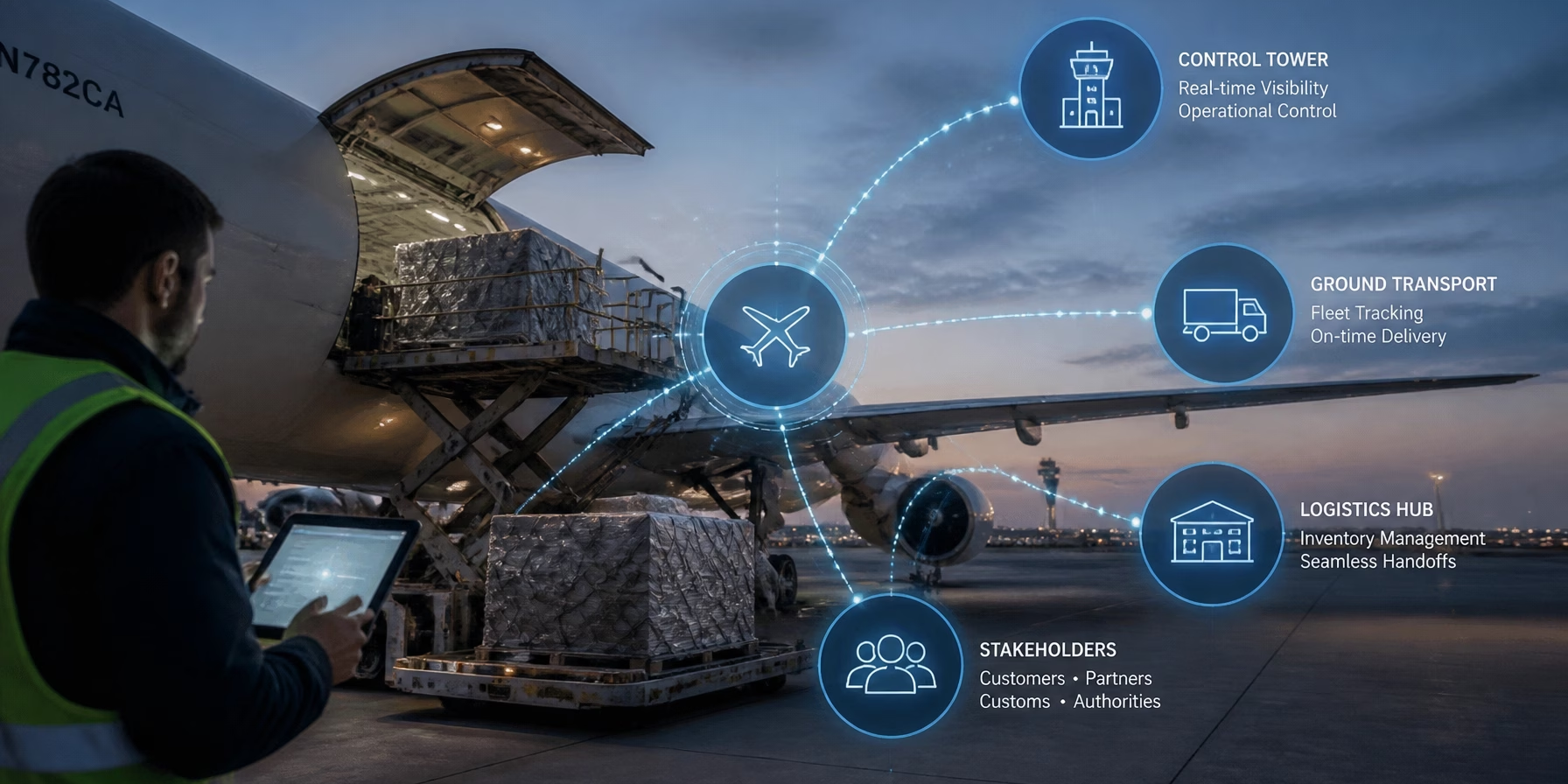
Plug-In Freight Ops™ is designed for Execution Accountability. It connects airlines, GSAs, freight forwarders, trucking providers, and government stakeholders into a single coordinated workflow.
The Core Capabilities of Digital Freight Infrastructure:
- Workflow Standardization: Moves the entire process (Quote → Book → Track) out of email and into a structured environment.
- Multi-Party Coordination: Connects every entity: from the airline to the DBE subcontractor: into one source of truth.
- Ecosystem Activation: Allows prime contractors and government agencies to manage diverse partner networks (including certified DBEs) with the same visibility as their internal teams.
- Structured Handoffs: Ensures that every time a shipment changes hands, the data is captured, verified, and made available for the next stakeholder.

Preparing Your Logistics "Plumbing" for AI
To actually make AI work in air cargo or infrastructure logistics, you have to fix the "digital plumbing" first. This means moving from a reactive, email-based culture to a structured execution culture.
Digital Freight Infrastructure provides the "clean data layer" that AI craves. When every interaction, handoff, and milestone is captured within a coordinated infrastructure, you finally have the data necessary to feed predictive models.
Imagine an AI that doesn't just "predict" a delay, but actually suggests a reroute based on the real-time capacity of your integrated trucking partners. That is only possible when the AI has an infrastructure layer to act upon.
The Operational Alignment Gap
Ecosystems don’t fail because freight moves. They fail when execution isn’t aligned.
Whether you are an airport authority coordinating multi-entity operations or a prime contractor managing a large-scale infrastructure program, the "Execution Gap" is your biggest risk. It is where delays happen, costs balloon, and accountability disappears.
By implementing Plug-In Freight Ops™, organizations can bridge this gap. The platform provides:
- Real-time Visibility: Knowing exactly where the execution stands at any moment.
- Audit-Ready Oversight: Every handoff and decision is logged and verified.
- Performance Tracking: Moving beyond "feelings" to hard data on partner accountability.

Moving Toward Coordinated Execution
The future of logistics isn't more disconnected software. It’s operational alignment. It’s about taking the 30 years of experience we have in the physical movement of goods and applying it to the digital coordination of those goods.
If your "AI Strategy" doesn't include a plan for Digital Freight Infrastructure, you are building on sand. You are asking a sophisticated algorithm to make sense of a broken, manual workflow.
At ImEx Cargo, we specialize in helping organizations transition from operational chaos to coordinated execution. We don't just "ship freight": we provide the infrastructure that makes execution possible.
What’s your next step?
We typically address these challenges through a focused 90-day pilot. During this time, we map your current operational "chaos" and demonstrate how a coordinated execution layer can reduce delays, improve risk management, and provide the clean data your long-term AI strategy requires.
Are you ready to move beyond the email chain?
Contact us today to walk through how this would apply in your specific operational environment.