Most logistics leaders are managing 21st-century complexity with 20th-century architecture.
In a globalized world, the greatest risk to a shipment isn't what happens inside your company: it’s what happens at the handoffs between companies. When an airline hands a shipment to a ground handler, or a freight forwarder coordinates with a drayage provider, the execution often falls into a digital black hole.
For decades, we’ve tried to solve this with better Transportation Management Systems (TMS). But a TMS is designed to optimize an individual organization. It was never built to coordinate an entire ecosystem.
To understand where we are going, we must look at how we got here. The evolution from paper to digital freight infrastructure is not just a change in software: it is a fundamental shift in how the industry views coordination.
The Stages of Logistics Evolution
The industry has moved through five distinct eras. Each stage solved a specific problem but eventually hit a ceiling as supply chains became more interconnected.

1. The Paper Era: Manual Planning
Before the digital revolution, logistics was a world of fax machines, phone calls, and carbon-copy manifests. Coordination was purely human. If a shipment was delayed, it took hours of manual "tracing" to find its location. Information latency was the norm, and errors were frequent.
2. The Spreadsheet Era: Early Digital Planning
The arrival of the PC brought spreadsheets. For the first time, planners could model scenarios and manage rate tables digitally. While this was a leap forward, the data remained siloed on individual desktops. It was "digital," but it wasn't "connected."
3. The TMS Era: Internal Optimization
The Transportation Management System (TMS) was the industry’s first major system of record. It automated carrier selection, freight rating, and internal dispatching. It made individual companies incredibly efficient.
However, a TMS stops at the corporate firewall. It is excellent at managing "my" freight, "my" carriers, and "my" costs. It struggles to manage "our" shared execution across multiple stakeholders.
4. The Visibility Era: Knowing "Where"
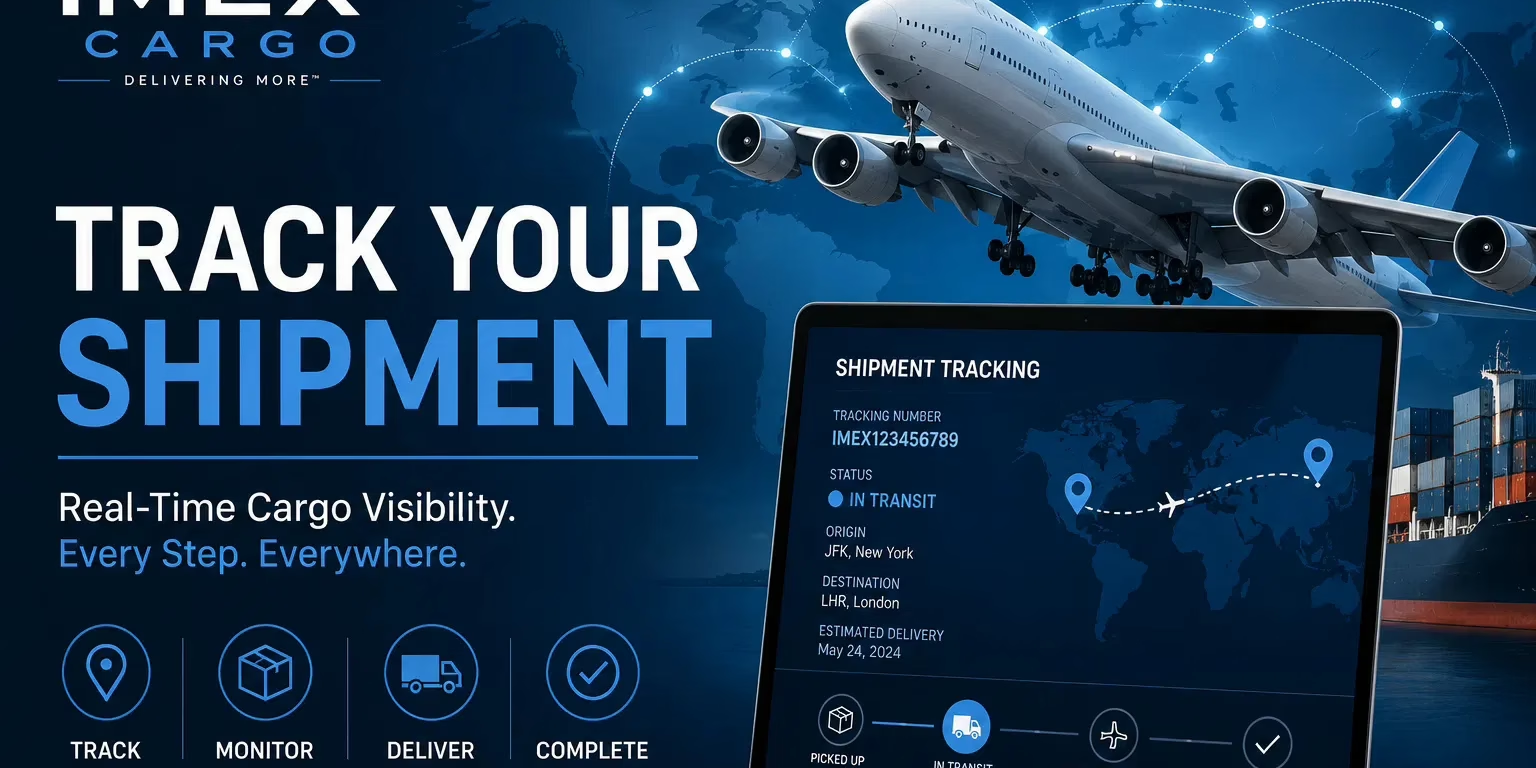
In the last decade, supply chain execution visibility platforms became the new gold standard. GPS and IoT sensors allowed us to see a shipment's location in real-time.
But visibility has a limit: it tells you where something is, but it doesn't tell you what should happen next. Knowing a shipment is stuck at a terminal is only half the battle; knowing who is accountable for moving it and having the workflow to trigger that action is the real challenge.
5. The Infrastructure Era: Execution & Orchestration
We have now entered the era of Execution Infrastructure.
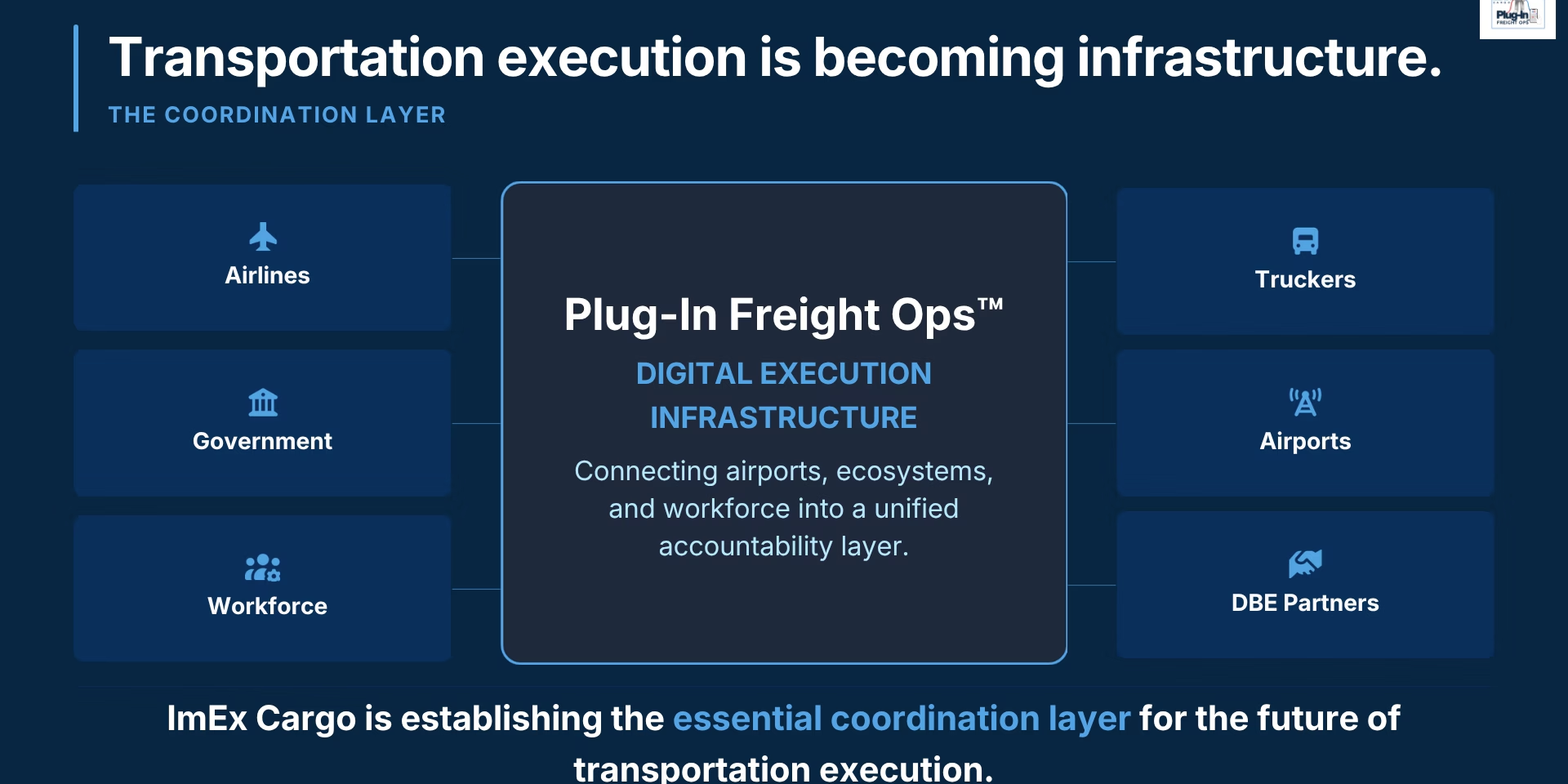
This is the shift toward a neutral coordination infrastructure that sits above existing systems. Rather than replacing your TMS or ERP, this logistics orchestration layer connects all parties: airlines, forwarders, truckers, and government agencies: into a single, unified execution environment.
Why Your TMS is Not an Execution Layer
Many organizations mistake their TMS for an execution platform. But there is a fundamental architectural difference.
A TMS is a "System of Record." Its primary job is to store data and manage transactions for a single entity.
In contrast, Plug-In Freight Ops™ is a "System of Coordination." It is designed as a cargo execution command center that manages the space between the records.
- Multi-Stakeholder Execution: A TMS manages your team. Digital freight infrastructure manages the handoffs between your team, the airline, the ground handler, and the terminal.
- Workflow Standardization: Most logistics failures happen because different partners have different definitions of "complete." Execution infrastructure enforces a structured workflow (quote → book → track → deliver) across the entire lifecycle.
- Accountability: In a standard TMS, if a partner fails to update a status, the system simply waits. In a freight execution platform, the system tracks the handoff and flags the responsible party in real-time.

The Rise of the Ecosystem Coordination Layer
As supply chains become increasingly fragmented, the ability to coordinate across multiple enterprises is no longer a luxury: it is a requirement for operational survival.
This is especially true in complex environments like air cargo and government infrastructure projects. These "high-stakes" shipments involve a massive web of stakeholders, including:
- Airlines and GSAs
- Freight Forwarders
- Trucking and Drayage providers
- Government and DBE partners
- Workforce and training pipelines
A governed logistics orchestration layer provides the connective tissue for these stakeholders. It ensures that everyone is working from the same "source of truth" regarding the execution of a project, not just the status of a shipment.
Bridging the Gap: From Tracking to Control
The core message for the modern logistics executive is simple: Visibility without execution is just a better way to watch your shipments fail.
We have enough tracking data. What we lack is the cargo execution infrastructure to act on that data automatically.
When you move from a TMS-only model to an execution infrastructure model, you gain:
- Certainty: Knowing exactly who has the freight and what the next step is.
- Speed: Eliminating the "email tag" that occurs during handoffs.
- Audit-Ready Oversight: Capturing every decision and handoff for compliance and transportation coordination.

The Future is the "Logistics Operating System"
The technology evolution is moving toward a freight operating system approach: a platform that acts like the "OS" for the physical world. Just as a computer OS manages the interactions between hardware and software, execution infrastructure manages the interactions between physical assets and digital stakeholders.
As we continue to build out the Plug-In Freight Ops™ network, we are moving beyond simple "shipping." We are building a supply chain execution layer that empowers every partner in the chain to perform at their highest level.
Next Steps for Your Operation
The transition from a siloed TMS to a coordinated execution infrastructure doesn't happen overnight, but it is the necessary next step for any organization managing complex logistics.
We typically begin this process by mapping your current stakeholder handoffs to identify where execution breaks down.
Ready to see how a coordination layer can complement your existing technology stack?
Schedule a capability walkthrough to explore how Plug-In Freight Ops™ can provide the execution certainty your operation requires.