In the world of high-stakes logistics, the "visibility" problem has been solved a thousand times over. We have GPS on every truck, sensors on every pallet, and portals for every airline. Yet, for airlines, General Sales Agents (GSAs), and Prime Contractors, the day-to-day reality of moving freight remains a fragmented mess of emails, spreadsheets, and manual workarounds.
Execution continues to break down not because we lack data, but because we lack infrastructure.
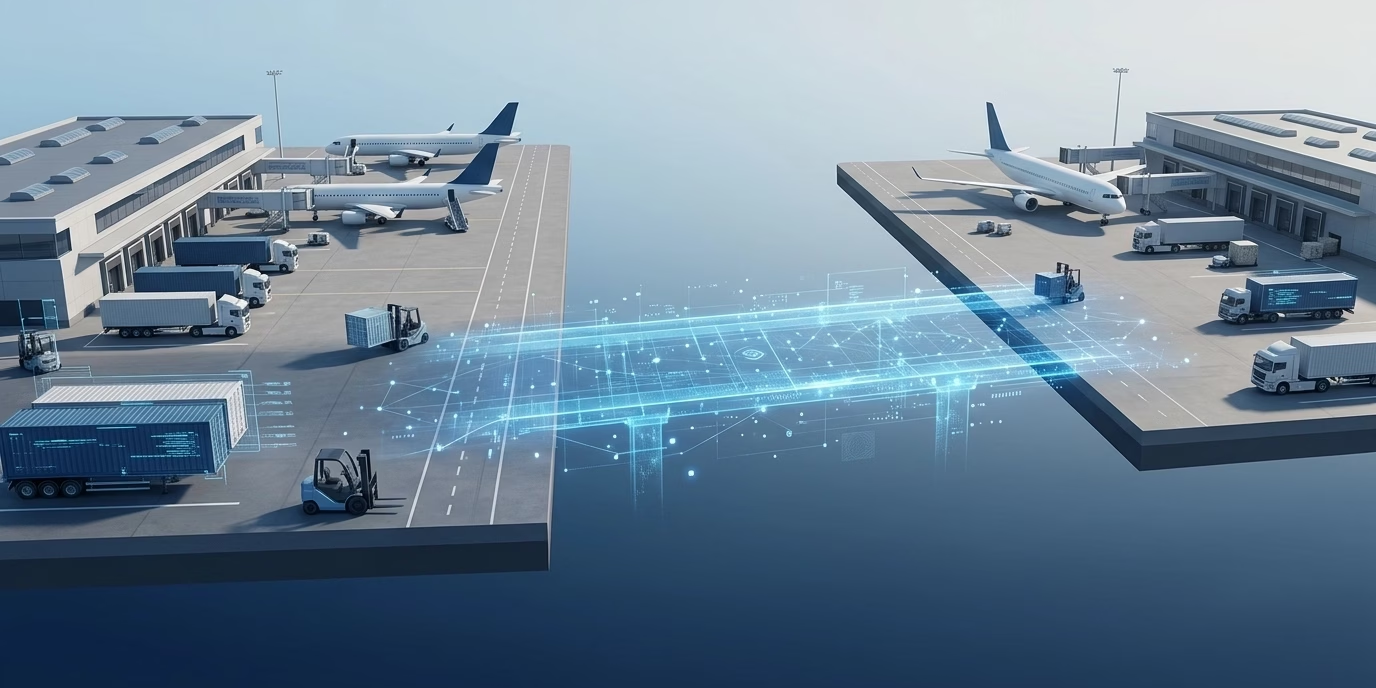
We are seeing a fundamental shift in how leaders approach logistics technology. The conversation is moving away from "SaaS tools" that solve narrow problems and toward Cargo Execution Infrastructure (CEI): a digital layer designed to coordinate movement across multiple stakeholders, systems, and handoffs.
The Fragmented Reality: Where Execution Breaks Down
Most logistics operations are currently managed in silos. An airline has its booking system; a trucker has a dispatch tool; a GSA has a sales CRM. When a shipment moves from one to the other, the coordination usually happens via a CC'd email or a phone call.
This fragmentation creates three primary risks:
- The Visibility Gap: You know where the plane is, but you don't know if the ground handler has received the paperwork or if the final-mile truck is actually on-site.
- The Accountability Deficit: When a delay occurs, identifying the responsible party involves a forensic audit of email chains rather than a clear digital trail.
- The Operational Ceiling: Scaling a network or taking on a large-scale infrastructure project becomes exponentially harder when every new partner adds a new layer of manual coordination.
Cargo Execution Infrastructure is the industry's response to this ceiling. It is the connective tissue that sits above these disconnected systems to standardize and manage execution across the full shipment lifecycle.

Defining Cargo Execution Infrastructure (CEI)
It is important to distinguish CEI from traditional Transportation Management Systems (TMS) or basic freight software.
Traditional software is built to help one company manage its tasks. Cargo Execution Infrastructure is built to help multiple stakeholders coordinate shared outcomes.
At ImEx Cargo, we deliver this through Plug-In Freight Ops™. It isn't a "rip-and-replace" platform that asks you to abandon your existing tools. Instead, it acts as a digital execution infrastructure layer that plugs into your current environment to provide:
- Workflow Standardization: Moving the process from quote to booking to tracking and delivery into a single, unified flow.
- Stakeholder Coordination: Connecting airlines, GSAs, forwarders, and trucking providers into one coordinated execution environment.
- Audit-Ready Oversight: Every handoff, status update, and document is captured in a structured system of record, providing immediate accountability.
Why Airlines and GSAs are Leading the Adoption
For airlines and GSAs, capacity is the product, but execution is the brand. If a booking is lost in an email thread or a GSA cannot provide real-time reporting to the airline, the relationship suffers.
By implementing an execution layer like Plug-In Freight Ops™, airlines can coordinate with their GSA networks and ground handlers in real-time. This reduces communication delays and provides a "cleaner" digital operating experience for the end customer.
Instead of managing 20-30 emails per shipment, operations teams work within a structured dashboard where the next step is always clear. This isn't just about efficiency; it's about institutional positioning. It signals to the market that your operation is infrastructure-ready and capable of handling complex, high-volume programs.

The Strategic Advantage for Prime Contractors
Prime contractors responsible for large-scale infrastructure projects or federal programs face a unique set of challenges. They aren't just moving freight; they are managing compliance, diverse supplier (DBE) participation, and multi-entity coordination.
Cargo Execution Infrastructure is particularly powerful in these environments because it activates partner ecosystems. The platform allows primes to:
- Coordinate Multi-Party Handoffs: Ensuring that materials move from the manufacturer to the site without the prime contractor needing to manual-manage every leg of the journey.
- Drive DBE Participation: Through dedicated portals, diverse suppliers can be seamlessly integrated into the workflow, meeting compliance goals without sacrificing operational speed.
- Maintain Executive Visibility: Leadership can see the status of every critical component in a single view, allowing for data-driven decisions rather than reactive crisis management.
Real-Time Visibility is the Floor, Not the Ceiling
Many companies think "visibility" is the end goal. They buy a tracking tool and assume the problem is solved. In a CEI environment, visibility is just the starting point.
The real value lies in actionable execution. It’s the difference between knowing a shipment is delayed and having a system that automatically alerts the next stakeholder in the chain, prompts a contingency booking, and logs the reason for the delay for a performance review.
Our Plug-In Freight Ops™ portal turns execution activity into usable reporting. This allows operators to move from "putting out fires" to "managing by exception."

Infrastructure as a Competitive Moat
In an increasingly commoditized logistics market, the winners will be the organizations that provide the highest level of execution certainty.
If you are an airline that can guarantee end-to-end visibility through your GSA network, you win. If you are a prime contractor that can provide an audit-ready trail of every DBE-carried load, you win.
Cargo Execution Infrastructure provides the framework for this certainty. It reduces the "noise" of manual logistics and replaces it with a structured, digital execution layer.
Implementation: The Pilot Pathway
The biggest barrier to digital transformation is often the fear of a massive, multi-year rollout. This is why we designed Plug-In Freight Ops™ as an infrastructure layer rather than a core system overhaul.
We typically address this for our partners through a focused pilot. This allows organizations to map their current operations, identify the specific "execution breaks," and deploy a coordination layer over a specific lane or project.
This approach:
- Reduces implementation risk.
- Provides immediate ROI through reduced manual labor.
- Strengthens the path from quote to booking without disrupting legacy systems.

Moving Forward
The logistics industry is at a crossroads. The manual workarounds that got us through the last decade are no longer sufficient for the complexity of modern global supply chains and infrastructure programs.
Cargo Execution Infrastructure is not just a trend: it is a requirement for any organization that intends to scale, coordinate across multiple stakeholders, and maintain absolute accountability.
Whether you are managing a global airline network or a multi-state infrastructure project, the question is no longer if you need a digital execution layer, but how quickly you can plug one in.
Are you ready to move beyond basic visibility and into structured execution?
We can walk through how this would apply in your specific environment or map this to your current operation. Contact our team today to discuss a pilot opportunity and see how Plug-In Freight Ops™ can transform your execution capability.